
Outsourced Phlebotomy Services: How the Options Compare and Which One Fits Your Facility
Outsourced phlebotomy services mean a vendor handles your blood draws, or supplies the people who do them, so your team does not. There are four ways to set it up, and they solve different problems. This guide compares them side by side and shows which one fits a home health office, a senior living community or a doctor’s office.
Phlebotomy On Wheels gives facilities nationwide two options, and you choose the one that fits your need: mobile phlebotomy for healthcare facilities when you need a draw done, or allied healthcare staffing when you need people on site.
What outsourced phlebotomy actually covers
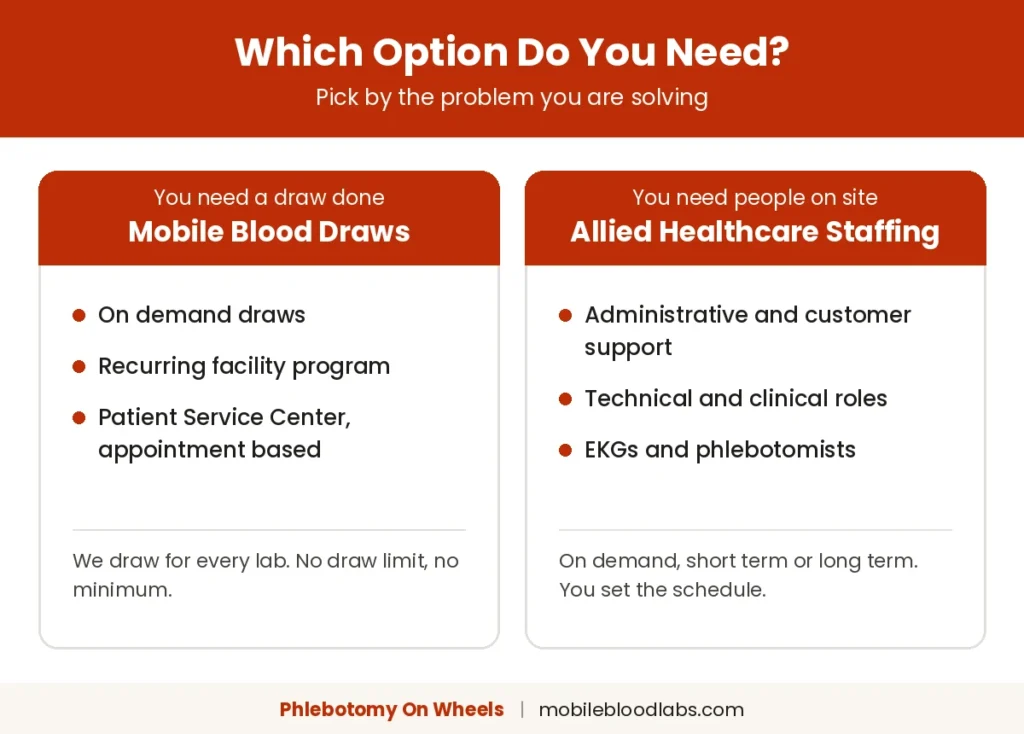
Facilities usually mean one of two things when they say outsourcing.
Outsourcing the draw
A vendor sends a phlebotomist to your patients, your building or their own center, draws the blood and gets the specimen to the lab the order names. Your team does not have to schedule or perform the draw.
Outsourcing the people
A vendor places staff in your building, on a schedule you set, for administrative, customer support, technical and clinical roles, including EKGs and phlebotomists. Your team stays in charge of the day, and you skip the hiring.
Most of the confusion comes from mixing these up. A clinic that sends a few patients out for blood work each month needs the first. A senior living community with three open roles needs the second. Which one you need depends on the problem you are solving.
Why facilities are outsourcing now
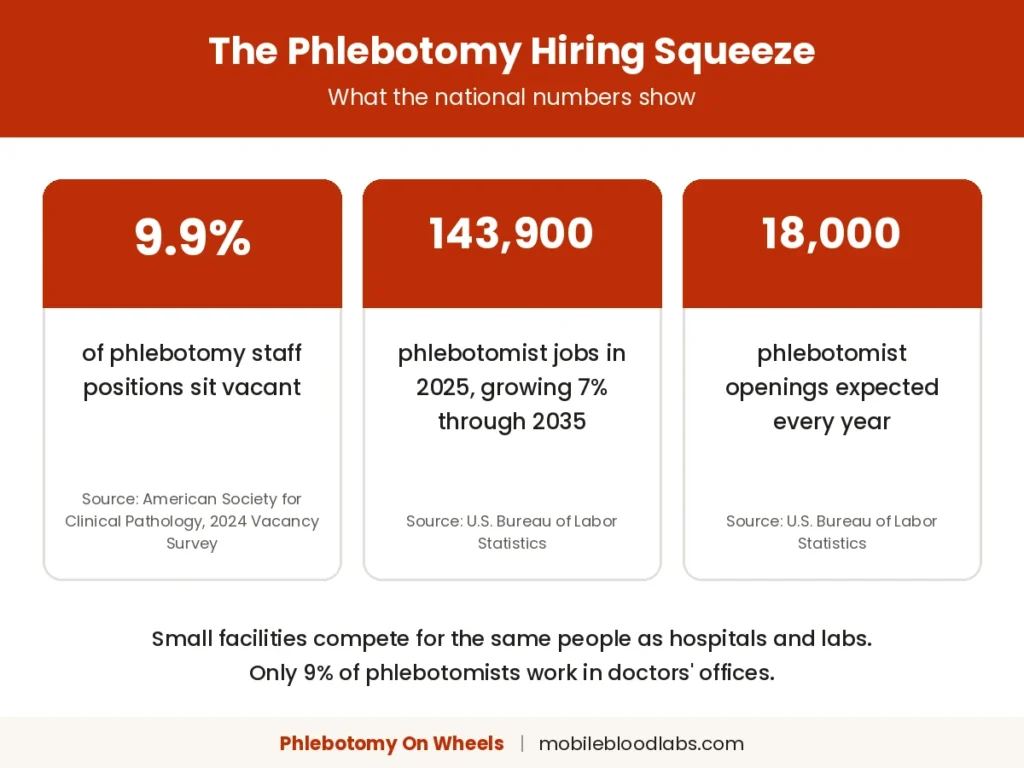
The labor market is the main push. The American Society for Clinical Pathology 2024 Vacancy Survey, which drew more than 1,000 responses from medical laboratories, found a 9.9% vacancy rate for phlebotomy staff positions, about 1 in 10 jobs sitting empty. The U.S. Bureau of Labor Statistics counts about 143,900 phlebotomist jobs in 2025, projects 7% growth through 2035 and expects about 18,000 openings a year.
Small facilities feel it most. BLS puts 36% of phlebotomists in hospitals and 33% in medical and diagnostic laboratories, and only 9% in doctors’ offices. A clinic or a home health office is often competing for the same people as hospitals and labs.
The draw itself matters too. A 2025 review of errors in one clinical laboratory, published in Clinical Chemistry and Laboratory Medicine, found that 98.4% of recorded errors happened in the pre analytical phase, the steps before testing that include collection. That is a single laboratory, so it is not a national rate. It does show where problems tend to start, and why who does the draw is worth a decision.
Four ways to outsource phlebotomy, compared
| Option | How it works | Best for | Watch out for |
|---|---|---|---|
| 1. On demand draws | You send an order and a time. A phlebotomist comes to the patient or your facility. | Doctors’ offices, home health visits, homebound patients, occasional draws | Check that the vendor draws for the lab your provider already uses |
| 2. Recurring facility program | Scheduled draws at your facility on set days, with no limit on volume | Senior living and nursing homes, group practices, steady monthly volume | Make sure there is no draw limit or minimum that caps you |
| 3. Patient Service Center, appointment based | You send patients to a draw center, booked ahead | Patients who can travel, solo providers sending one patient at a time | Distance. A center only helps patients who can get there |
| 4. Allied healthcare staffing on site | A placed person works in your building on your schedule, on demand, short term or long term | Open roles you need filled on site: administrative, customer support, technical and clinical, including EKGs and phlebotomists | Ask whether the vendor vets and background checks its team so you do not have to |
If your problem is draws, start with options 1 to 3. If your problem is open roles, start with option 4. You choose staffing or mobile blood draws based on what you need.
For senior living and nursing homes, the volume difference matters. Mayo Clinic Laboratories notes that skilled nursing facility patients need frequent testing, enough that a lab can often justify phlebotomy visits several times a week, while assisted living residents are generally in better health and need testing less often. That is why recurring programs fit one and on demand fits the other. The CDC counts about 31,400 residential care communities in the U.S. in 2025, so the demand is spread across a lot of small sites.
Signs it is time to outsource
You do not need a crisis to justify it. Common signs:
- A draw gets pushed because the one person who does them is out
- Nurses or front desk staff are pulled into draws they were not hired for
- Your providers use more labs than you can keep arrangements with
- Patients are sent elsewhere for blood work because you cannot fit it in
- A role has been open for weeks and the work is landing on everyone else
- Your census or patient list is growing and the current setup cannot stretch further
If two or three of these sound familiar, it is worth a conversation.
In house versus outsourced: what actually changes
When you hire in house, you own the recruiting, the training, the scheduling, the backup plan for call outs and the relationship with every lab. When you outsource, much of that moves to the vendor. What stays with you is the decision of what you need and when.
That is why outsourced phlebotomy services tend to suit facilities with uneven volume. A full time hire is the same cost in a slow week as in a busy one. An outsourced setup follows your volume: more draws in a busy month, fewer in a quiet one, and no one on payroll in between. For staffing, the same logic applies. Our allied healthcare staffing is on demand, short term or long term, and you set the schedule, so you can add help for a busy stretch without a permanent commitment.
Common mistakes when outsourcing phlebotomy
Hiring one vendor per lab
It looks simple until your providers send orders to four labs and you are managing four relationships. One vendor that draws for every lab removes the problem.
Ignoring volume limits
Some arrangements cap the number of draws or require a minimum. Ask early, because a cap shows up at the worst time, when you are busiest.
Treating draws and staffing as the same thing
They solve different problems. Decide which one you actually need before you compare vendors.
Choosing on location alone
A draw center only helps patients who can reach it. Homebound and senior patients usually need someone to come to them.
Skipping the paperwork question
Ask how orders reach the vendor and how the specimen gets to the lab. Email, fax or portal for orders and a clear drop off at the lab the order names keeps the chain of custody clean.
What makes Phlebotomy On Wheels different
Here is what we do, and what it means for you.
We draw for every lab
Your providers use different labs. We draw for whichever laboratory the order requires, and your lab choice stays yours. You do not manage one draw vendor per lab.
No limit on draws and no minimum to start
Send one patient or a full program. The service grows when you do.
Three ways to draw
We come to your patients’ homes, come to your facility, or see patients at our Patient Service Center in Columbia, Maryland, appointment based.
You pick what fits
Choose mobile blood draws when you need a draw done, or allied healthcare staffing when you need people on site. Allied healthcare staffing covers administrative, customer support, technical and clinical roles, including EKGs and phlebotomists, and each role is its own placement, so you add only the help you need.
A vetted team
Our team is vetted and background checked, and our staff is certified and licensed, so you do not have to repeat that work.
Hard sticks and every age
We draw patients of all ages, including children and difficult veins.
Handled the right way
We are HIPAA compliant, with chain of custody on every draw.
Works the way you already work
Send orders by email, fax or portal. We use your kit or bring the supplies, and we drop the specimen at the lab the order names.
Nationwide
One vendor for a single office or several locations.
We are not a laboratory, and we are self pay only. We do not bill insurance, Medicare or Medicaid.
Which option fits your facility
Home health
Blood draws add time to visits that are already full. On demand draws let a phlebotomist handle the draw, so the visit stays focused on care.
Assisted living and nursing homes
Residents see many doctors who use many labs. A recurring draw program covers all of them with one vendor, or staffing covers open roles on site.
Doctors’ offices and clinics
Solo doctors and group practices whose patients use different labs do well with on demand draws, or with staffing when the front office or floor is short.
Laboratories
Draws only, for patients who cannot get to a draw site. We draw at home or at a facility and drop the specimen where the order or kit says.
Not Sure Which Option Fits? Tell our team what your facility needs, mobile blood draws or allied healthcare staffing, and we will point you to the right setup.
Schedule a MeetingHow to get started
- Tell us what you need. Mobile blood draws or allied healthcare staffing, and roughly how often.
- Meet with our team. A short call or meeting settles the setup. Pricing is covered in that conversation, not on this page.
- Send the first order. Email, fax or portal, with the patient’s address and a time that works.
Prefer email? Write to sales@mobilebloodlabs.com.
Frequently Asked Questions
What are the options for specimen collection outside the facility, and how do they compare?
There are four ways to outsource: on demand draws, a recurring facility program, a Patient Service Center that is appointment based, and allied healthcare staffing on site. Draws fit visit based needs and staffing fits open roles on site.
What are outsourced phlebotomy services?
A vendor either performs the blood draws for you or supplies the staff who do them. Phlebotomy On Wheels offers mobile blood draws and allied healthcare staffing, and you choose the one that fits your need.
Our clinic cannot keep consistent phlebotomy coverage. What do we do?
Use mobile blood draws for the draws themselves, or allied healthcare staffing when you need someone on site. Staffing runs on demand, short term or long term.
Do you draw for every lab?
Yes. We draw for whichever laboratory the order requires, and your lab choice stays yours.
Is there a limit on how many draws we can send?
No. There is no draw limit and no minimum to start.
Is your team vetted?
Yes. Our team is vetted and background checked, and our staff is certified and licensed.
Can you draw children and difficult veins?
Yes. We draw patients of all ages and handle difficult draws.
Do you provide nurses?
No. We do not staff nurses, aides, therapists or doctors.
Do you bill insurance?
No. We are self pay only and do not bill insurance, Medicare or Medicaid.
Ready To Take Draws Or Open Roles Off Your Plate?
Sources
- American Society for Clinical Pathology. 2024 Vacancy Survey of medical laboratories in the United States. American Journal of Clinical Pathology, 2025.
- U.S. Bureau of Labor Statistics. Occupational Outlook Handbook, Phlebotomists.
- Pre analytical phase errors constitute the vast majority of errors in clinical laboratory testing. Clinical Chemistry and Laboratory Medicine, 2025.
- Hermansen J. Managing off-site phlebotomy: Considerations, coordination, and convenience. Mayo Clinic Laboratories, 2024.
- CDC National Center for Health Statistics. National Post-acute and Long-term Care Study, residential care communities.