
Blood Specimen Rejection: Causes and How to Prevent Redraws

Picture the call. A lab phones your facility at 2 p.m. The sample from room 14 is hemolyzed and needs a redraw. The resident already ate, the nurse is on another hall, and the physician wanted that result today. That call is blood specimen rejection, and it is rarely a lab problem. It starts at the draw and shows up at the lab.
The research agrees. A 2025 review of 37.7 million results at one core laboratory found that 98.4% of its errors were preanalytical, meaning they happened before the sample reached an analyzer. A 2025 study of more than 2 million samples found clotted blood was the top reason for rejection. Below is what causes rejection, why it hits long term care and home health hardest, and what cuts redraws. If you run lab operations, our page on mobile phlebotomy for laboratories covers the draw side.
What Is Blood Specimen Rejection?
Blood specimen rejection is when a lab refuses to test a blood sample because it can’t produce a reliable result. The sample is clotted, hemolyzed, too small, mislabeled or in the wrong tube. The lab asks for a redraw, the result is delayed, and the patient gets stuck a second time.
Why Do Labs Reject Blood Samples?
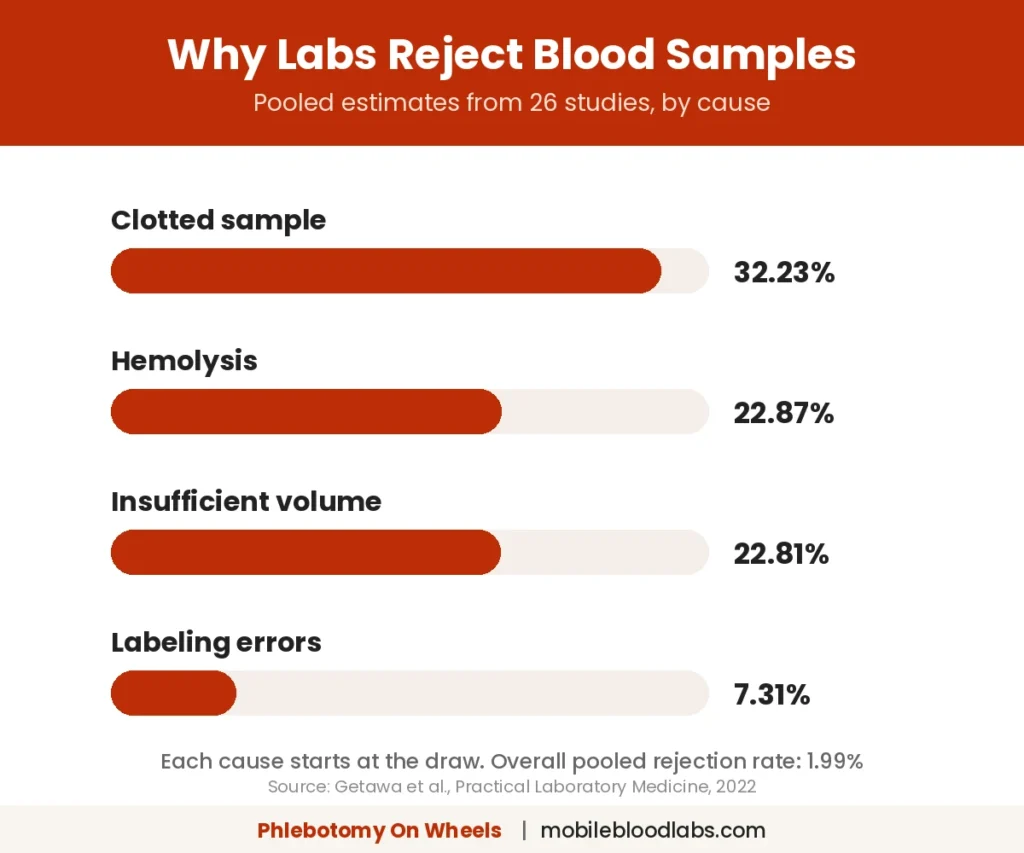
A systematic review and meta analysis of 26 studies, covering more than 16 million blood sample requests, ranked the causes. Clotted samples led at 32.23% of rejections. Hemolysis followed at 22.87%, insufficient volume at 22.81%, and labeling errors at 7.31%. Each one starts at the draw:
- Clotted: the tube wasn’t inverted right away, or not as many times as its maker specifies. Inversion counts differ by tube type, so follow the instructions for each tube.
- Hemolyzed: red cells broke on the way into the tube or after it. Hemolysis releases potassium, so the sample can read falsely high and the lab won’t run it. One habit to drop: asking the patient to pump a fist before the draw. Flexing muscle releases potassium too.
- Insufficient volume: the tube is short of the fill line, so the blood to additive ratio is wrong.
- Labeling errors: the Joint Commission requires at least two patient identifiers when collecting blood samples, and tubes labeled in front of the patient. A room number doesn’t count as an identifier, and labeling tubes before you see the patient isn’t acceptable.
Why Is Blood Specimen Rejection Worse in Long Term Care and Home Health?
Because the draw happens in the least controlled setting in healthcare. The resident moved rooms overnight. Another one is asleep, or has dementia and can’t confirm their own name. A vague order like “liver tests” has to be clarified before anyone knows which tubes to pull. Fasting labs leave a narrow window before breakfast.
Then there is timing. Peak and trough draws for IV antibiotics only mean something if the draw matches the dose, and a late dose leaves the phlebotomist with a mistimed draw. Every test also has a stability window, so a slow handoff to the courier can spoil a good sample. Mayo Clinic Laboratories notes that some skilled nursing patients need multiple blood draws per week plus frequent STAT requests. Every one of those is a chance for a recollect.
How Do You Reduce Blood Specimen Rejection?
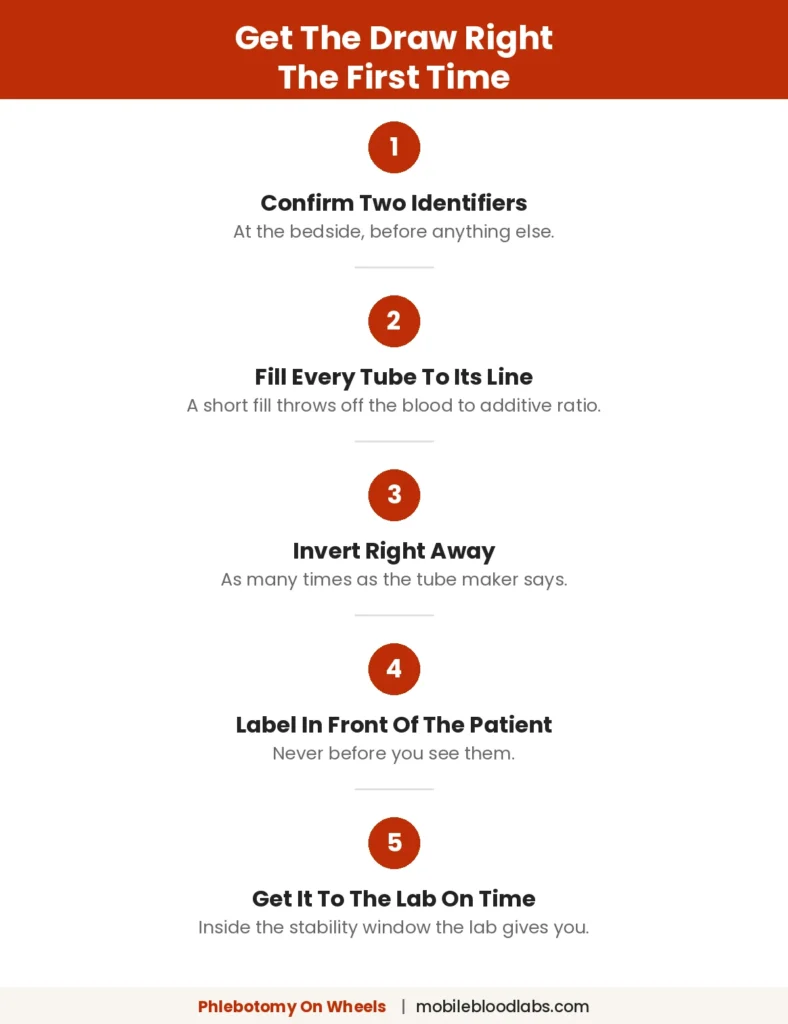
Reduce blood specimen rejection by fixing collection, because collection is where most errors start. Confirm two identifiers at the bedside, fill tubes to the line, invert them right away, match each tube to the order, and get the sample to the lab inside its stability window. Then track rejections by cause so you can see the pattern.
- Clarify vague orders before the draw. Name the tests, so the draw team knows the tubes.
- Schedule fasting draws early. Tell the draw team the order is fasting.
- Confirm two identifiers at the bedside and label the tube there, before leaving the room.
- Fill every tube to its line, then invert it immediately.
- Get the specimen to the lab inside its time window, especially serum that must be separated.
- Log every rejection by cause and by unit. Patterns show up fast once you write them down.
Redraws piling up? Talk to our sales team, or pick a time that works for you.
Talk to SalesSchedule a MeetingWhen Should a Facility Hand Draws to a Mobile Phlebotomy Service?
When the same causes keep coming back. Four signs:
- The lab keeps calling for redraws on the same units or shifts.
- Residents with difficult veins get stuck more than once.
- STAT requests keep breaking up your draw route.
- Draw days depend on whoever is on shift.
A partner who draws every day follows the same order of draw, fill lines and labeling steps every time. Phlebotomy On Wheels sends trained phlebotomists across the country, handles hard sticks and difficult veins, draws patients of all ages, and documents chain of custody from the draw to the drop. We are HIPAA compliant. We collect the sample, and your lab runs the test. See how it works for mobile phlebotomy for healthcare facilities , including assisted living and nursing homes
A partner won’t fix an unclear order or a slow courier, so sort those out too. Our post on outsourced phlebotomy services compares the options if you are weighing in house against outside help.
A Check You Can Run This Week
Pull the last 30 days of redraw calls from your lab. Sort them by reason. If clotted, hemolyzed, short fill and labeling account for most of them, you have a collection problem, and that is fixable. If they don’t, the cause sits somewhere else, and now you know where to look.
Ready to take blood draws off your staff’s plate? Talk to our sales team, or schedule a meeting.
Talk to SalesSchedule a MeetingFrequently Asked Questions
What is blood specimen rejection?
Blood specimen rejection is when a lab refuses to test a blood sample because it can’t produce a reliable result. The sample may be clotted, hemolyzed, too small, mislabeled or in the wrong tube, and the lab asks for a redraw.
What are the most common reasons a lab rejects a blood sample?
Clotted samples, hemolysis, insufficient volume and labeling errors. Pooled estimates from a review of 26 studies put them at 32.23%, 22.87%, 22.81% and 7.31% of rejections, in that order.
Does a rejected blood sample mean the patient needs another draw?
Usually yes. The lab can’t test an unreliable sample, so it asks for a new one, and the result is delayed until the redraw reaches the lab.
How can nursing homes and assisted living facilities reduce rejected blood samples?
Clarify orders before the draw, confirm two patient identifiers at the bedside, fill tubes to the line, invert them right away as the tube maker instructs, and get specimens to the lab within their stability window. Track every rejection by cause so you can see the pattern.
Can a mobile phlebotomist help reduce redraws?
It can help. A phlebotomist who draws every day follows the same order of draw, fill lines and labeling steps each time. Phlebotomy On Wheels handles hard sticks and difficult veins and draws patients from pediatric to older adults. A mobile service can’t fix an unclear order, so clarify the tests before the draw.
Does Phlebotomy On Wheels test the samples it collects?
No. We collect the sample, and your lab runs the test. Every specimen is tracked from the draw to the drop, and Phlebotomy On Wheels is HIPAA compliant.
Which option fits your facility
Related Articles
Sources
- Lin Y, Spies NC, Zohner K, McCoy D, Zaydman MA, Farnsworth CW. Pre-analytical phase errors constitute the vast majority of errors in clinical laboratory testing. Clinical Chemistry and Laboratory Medicine, August 2025.
- Cheng X, Yu H, Zhang L, Zhang B, Wang Q. Evaluation of pre-analytical specimen rejection using Six Sigma metrics: A retrospective single-center study. PLOS ONE, June 3, 2025.
- Getawa S, et al. Blood specimen rejection rate in clinical laboratory: a systematic review and meta analysis. Practical Laboratory Medicine, 2022.
- The Joint Commission. Two Patient Identifiers: Understanding the Requirements. National Patient Safety Goals, NPSG.01.01.01.
- Mayo Clinic Laboratories. Best practices for supporting lab testing in skilled nursing facilities. Mayo Clinic Laboratories News, May 18, 2026.
- Centers for Disease Control and Prevention. Teaching Healthcare Staff to Draw Blood for Accurate Diagnosis and Patient Safety. CDC Lab Week archive.