
Therapeutic Phlebotomy for High Hemoglobin — Now What?
Most people hear the words therapeutic phlebotomy for high hemoglobin for the first time in a phone call they were not expecting.
You went in for a routine blood draw, the kind you have done a dozen times before. Nothing felt different. You were not in pain. You were not particularly tired. Life was moving along at its normal pace. Then your provider called, told you your hemoglobin was too high, and scheduled a procedure you had never heard of before.
You wrote down the words, thanked them, hung up, and immediately searched the internet trying to figure out what that actually means.
If that is where you are right now, or if you are a caregiver trying to understand what someone you love has just been prescribed, you are in the right place. This is everything you need to know, explained the way it should have been explained in that phone call.
This guide covers everything patients and caregivers need to know about therapeutic phlebotomy for high hemoglobin. From what the procedure involves to how to get it done without leaving home.

What Is Actually Happening in Your Blood
Your blood is made up of several components, plasma, platelets, white blood cells, and red blood cells. Hemoglobin is the protein inside those red blood cells. Its job is to carry oxygen from your lungs to every tissue and organ in your body.
When hemoglobin levels are in the normal range, your blood flows smoothly and efficiently. Oxygen gets where it needs to go. Your heart works at a comfortable pace to push everything through.
But when hemoglobin climbs too high, something counterintuitive happens. Your blood gets thicker. Not in a way you can feel immediately, not like a pulled muscle or a headache that announces itself, but at a cellular level, the consistency of your blood changes. It becomes more like syrup than water moving through a narrow straw.
Your heart has to work harder. Circulation slows. Blood flow to your brain, your extremities, and your organs becomes less efficient. And even though you have more oxygen-carrying cells than ever, your body is actually receiving less oxygen than it should, because thick blood cannot move through your vessels the way it needs to.
Left unmanaged, elevated hemoglobin significantly increases the risk of blood clots, cardiovascular complications, and other serious outcomes. According to the Cleveland Clinic, therapeutic phlebotomy is one of the most effective and well-established treatments for managing elevated red blood cell concentration. This is why your provider did not just monitor it and wait. This is why they prescribed therapeutic phlebotomy for high hemoglobin.

What Therapeutic Phlebotomy for High Hemoglobin Actually Is
In the simplest possible terms, it is a controlled, medically prescribed blood draw that removes a measured amount of blood from your body to bring your hemoglobin levels back into a safe range.
That is it. That is the treatment.
From the outside, a therapeutic phlebotomy procedure looks almost identical to donating blood. A certified phlebotomist inserts a needle, blood flows into a sterile collection bag, and the whole thing is typically done in 30 to 45 minutes. You sit comfortably, stay hydrated, and when it is over you rest for a few minutes before carrying on with your day.
The difference between a therapeutic blood draw and a blood donation is not what happens during the procedure, it is why it is happening and who is directing it. This is not voluntary. This is a prescribed medical treatment, ordered by your provider, with a specific volume to remove and a specific schedule to follow. Every detail is deliberate.
After each session your body naturally begins producing new red blood cells to replace what was removed. Over the following days your hemoglobin levels drop toward the target range your provider is aiming for. Most patients notice the difference within a week, more energy, clearer thinking, less of that low-grade fatigue that high hemoglobin can quietly cause for months before anyone puts a name to it.
Who Gets Prescribed Therapeutic Phlebotomy for High Hemoglobin and Why
There is no single type of patient who gets prescribed therapeutic phlebotomy for high hemoglobin. The reasons vary widely. Here are the most common situations.
When the Body Overproduces Red Blood Cells
Some people develop conditions where the bone marrow produces significantly more red blood cells than the body actually needs. The result is chronically elevated hemoglobin and hematocrit. Therapeutic phlebotomy is the primary treatment in these cases, not a temporary fix, but an ongoing management tool that keeps levels in a safe range over the long term.
When the Body Stores Too Much Iron
Iron is stored inside red blood cells. For people whose bodies absorb more iron than they can process and use, that iron accumulates in organs over time — the liver, the heart, the joints — causing damage that builds quietly and seriously. Removing blood removes the excess iron. Research published through the National Institutes of Health confirms that therapeutic phlebotomy is the primary treatment for hereditary iron overload and is effective as a lifelong maintenance tool for most patients.
When Testosterone Therapy Raises Hemoglobin Levels
Testosterone replacement therapy stimulates red blood cell production. In some patients those levels climb too high, raising both hemoglobin and hematocrit above safe thresholds. Therapeutic phlebotomy for high hematocrit and hemoglobin is a standard part of managing this situation, typically used alongside adjustments to the therapy itself until levels stabilize.
When Therapeutic Phlebotomy for High Hemoglobin Is Prescribed Without a Confirmed Diagnosis
Sometimes a patient’s levels are simply high — elevated without a confirmed underlying diagnosis. Therapeutic blood draws are used both to bring levels down and to monitor how the body responds over time while further investigation continues. In these cases, routine blood draws between sessions are essential for tracking progress and adjusting the schedule.
The common thread in all of these situations is this — the body is producing or holding onto more than it should, and the most effective way to correct that is to remove some of it. Therapeutic phlebotomy is elegant in its simplicity. Your body responds, adjusts, and given the right schedule, maintains healthier levels over time.

What to Expect Before, During, and After Your Therapeutic Draw
Knowing what actually happens during a therapeutic phlebotomy procedure makes the experience significantly less stressful, especially for first-timers.
The Day Before and Morning Of
Hydrate. This is the single most important thing you can do before a therapeutic blood draw. Drink water consistently in the 24 hours leading up to your appointment. Well-hydrated veins are easier to access, the draw moves faster, and you will feel better during and after.
Eat a light meal before the procedure, never arrive on an empty stomach. Wear comfortable clothing with a sleeve that rolls up easily to your elbow. That is genuinely all the preparation you need.
During the Procedure
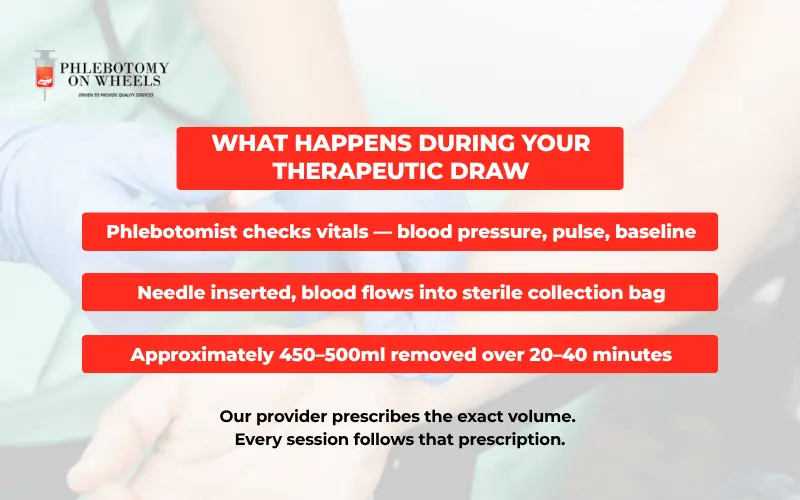
Your certified phlebotomist will start by checking your blood pressure, pulse, and other baseline vitals. This is standard practice before every therapeutic draw, it confirms you are safe to proceed and gives the phlebotomist a baseline to monitor against.
They will select a site on your arm, clean the area thoroughly, and insert a needle. Blood begins flowing into a sterile collection bag. Most therapeutic sessions remove approximately 450 to 500 milliliters — roughly one pint — though your provider may prescribe a different volume based on your specific levels and health history.
The draw itself takes between 20 and 40 minutes for most patients. You will feel mild pressure at the needle site. That is typically all. Some patients read during this time. Others simply rest. The key is to stay relaxed and keep sipping water throughout.
After the Procedure
When the collection is complete your phlebotomist removes the needle, applies gentle pressure to the site, and bandages it. Rest for a few minutes before standing. Plan to take it easy for the rest of the day — no strenuous exercise, continued hydration, and a normal meal.
Mild fatigue or brief light-headedness immediately after the draw is completely normal. Your body just released a pint of blood and it needs a few hours to adjust. By the following morning most patients feel noticeably better than they did going in.
Your provider will schedule follow-up lab work to check how your hemoglobin responded and whether additional sessions are needed.
How Often Is Therapeutic Phlebotomy for High Hemoglobin Needed
This is the part of the conversation most patients are not prepared for — because for many people, therapeutic phlebotomy is not a one-time procedure.
The frequency depends entirely on your specific levels, your provider’s protocol, and how your body responds after each draw. Some patients need sessions weekly or twice a month during an initial phase while levels come down into the target range. Others reach a quarterly maintenance schedule once stability is achieved.
What this means practically is that therapeutic phlebotomy often becomes a regular part of someone’s routine. Not forever with the same intensity, the frequency typically decreases significantly once target levels are reached, but as an ongoing tool for keeping the body in balance.
And this is exactly where the question of where the procedure happens matters most. If you need a therapeutic blood draw every few weeks indefinitely, the logistics of repeated clinic visits add up fast. For many patients, this friction is the single biggest reason they fall behind on their prescribed schedule. Not because they do not want to comply. Because life gets in the way.
If you are managing a recurring therapeutic phlebotomy schedule, a standing order arrangement allows a certified mobile phlebotomist to come to your location automatically on a pre-set schedule, no individual scheduling calls required between sessions. Learn more about standing orders.

Does Therapeutic Phlebotomy for High Hemoglobin Have to Happen at a Clinic
No. And this surprises most people.
A certified mobile phlebotomist can come to your home, your workplace, your assisted living facility, or any other location and perform your therapeutic phlebotomy at home with the exact same clinical standards as any outpatient setting. Same sterile equipment. Same documented protocols. Same accredited process. Same results returned to your provider.
The only thing that changes is where it happens.
For patients who need this done once, the difference might feel small. But for someone managing a long-term care plan that involves recurring therapeutic draws, having a certified professional come to them changes everything about whether that plan is sustainable.
Think about a senior patient whose family member drives them to a clinic every three weeks. Or a person managing their care alone who relies on public transportation. Or simply someone whose work schedule makes repeated daytime clinic visits genuinely difficult. For all of them, mobile therapeutic phlebotomy is not just a convenience, it is what makes consistent care actually possible.
Phlebotomy On Wheels provides certified mobile phlebotomy for therapeutic draws at your home, workplace, or care facility nationwide. We work directly with your provider, follow your prescription exactly, and handle all documentation on both ends. If you are looking for therapeutic phlebotomy near me that comes to you rather than requiring travel, we are the provider built specifically for that.
Learn more about our therapeutic phlebotomy service or call (443) 866-3647 to talk through your situation with our team.
How to Set Up Therapeutic Phlebotomy at Your Location
Setting up therapeutic phlebotomy for high hemoglobin at your location is straightforward once you know what is needed.
The process is simpler than most patients expect.
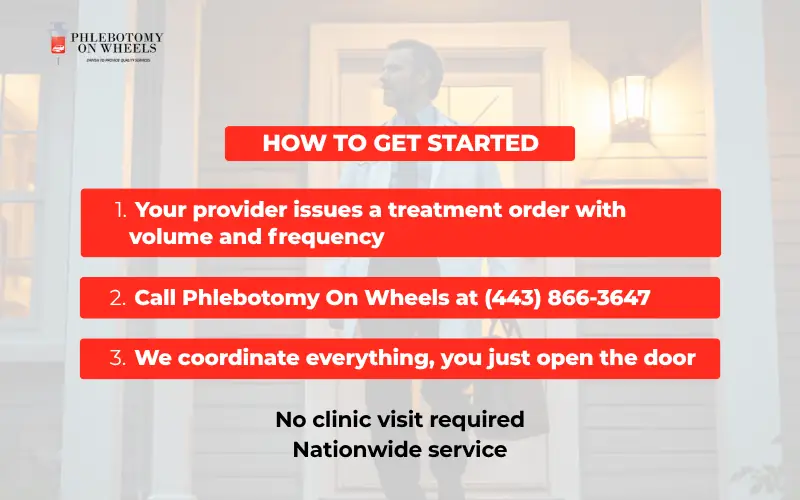
You need a written prescription or provider order specifying your diagnosis, the volume to be removed per session, and how frequently the draws should occur. If your provider has already prescribed this treatment, they can send that order directly to us.
From there we confirm your schedule, assign a certified mobile phlebotomist, and coordinate with your provider to ensure documentation flows correctly after each session. You do not manage the logistics between your provider and our team, we handle that coordination directly.
Call us at (443) 866-3647 or visit our mobile phlebotomy services page to get started. We are available Monday through Friday, 7:00 AM to 7:00 PM EST, nationwide.
Frequently Asked Questions
Hemoglobin is the oxygen-carrying protein inside your red blood cells. Hematocrit is the percentage of your total blood volume made up of red blood cells. When red blood cell production increases, both values rise together. Therapeutic phlebotomy for high hematocrit and therapeutic phlebotomy for high hemoglobin refer to the same procedure targeting the same underlying issue. Your provider specifies which values they are monitoring and what the target range is.
The therapeutic blood draw itself may be covered by insurance when medically prescribed for a qualifying condition. Many patients find that therapeutic phlebotomy for high hemoglobin qualifies for partial or full coverage when properly documented by their provider. The mobile service fee for having it performed at your home is typically a separate cost not covered by most insurance plans. Contact your insurance provider with your diagnosis code to confirm coverage for the procedure. Our team can also help clarify your options, call (443) 866-3647.
No doctor’s order is required to book with Phlebotomy On Wheels. We accept orders from all healthcare providers. Patients can also arrange their own tests directly through our authorized lab partners, no referral needed. Since therapeutic phlebotomy is a prescribed treatment, your provider will typically issue a treatment order specifying volume and frequency. Simply call us at (443) 866-3647 and we will guide you through the entire process from start to finish. See our full guide on therapeutic phlebotomy medical supervision for a complete walkthrough of what to expect
Most home-based sessions take between 30 and 45 minutes from arrival to completion — including pre-draw vitals, the collection itself, and post-draw care.
Light activity is fine within a few hours of your session. We recommend avoiding strenuous exercise for the rest of the day, staying well hydrated, and eating normally. Your phlebotomist will give you specific aftercare guidance before they leave.
A standing order arrangement is the simplest solution for patients who need recurring therapeutic draws. You establish the schedule once and a certified mobile phlebotomist comes to your location automatically at the agreed frequency. Whether you need an at home blood draw weekly, monthly, or quarterly, we build your schedule around your provider’s prescription. If you have been searching for therapeutic phlebotomy near me on a recurring basis, standing orders are the answer. Learn more at https://www.mobilebloodlabs.com/standing-orders/
The Bottom Line
Most people who are prescribed therapeutic phlebotomy for high hemoglobin have never heard of the procedure before that phone call. Therapeutic phlebotomy for high hemoglobin is one of the most manageable prescribed treatments available, once you understand what it involves. They leave the conversation with a prescription, a list of questions, and no clear picture of what comes next.
What comes next is actually straightforward. A 30 to 45 minute procedure. A certified professional. A measured draw. A body that responds and adjusts. And for most patients, a noticeable improvement in how they feel within days.
It does not have to happen at a clinic. It does not have to mean rearranging your schedule around someone else’s availability. And it does not have to feel overwhelming.
Book Your Therapeutic Phlebotomy at Home →
Same accredited labs. Same certified professionals. Just a more manageable way to stay on your prescribed care plan.
Related services you may need:
- Therapeutic Phlebotomy: Our dedicated therapeutic phlebotomy service page
- Mobile Phlebotomy Services: All services, all ages, nationwide
- Standing Orders: Set up your recurring draw schedule once, we handle the rest
- Routine Blood Draws: Scheduled blood draws at your location
Sources and Citations
- Cleveland Clinic — Therapeutic Phlebotomy
- National Institutes of Health, PubMed Central — Therapeutic Phlebotomy in Iron Overload Conditions
- MedlinePlus, National Library of Medicine — Hemoglobin Test
- National Heart, Lung, and Blood Institute — Blood Tests
This article is for educational purposes only and does not constitute medical advice. Always follow your healthcare provider’s specific instructions regarding your therapeutic phlebotomy prescription, volume, frequency, and treatment plan.
Walk in Available
2 Responses