
Why Patients Skip Blood Draws, and How Doctors’ Offices Get Them Done Anyway

A patient leaves your office on a Thursday with a lab order. Fasting, any morning next week. Two weeks later the order is still open and nobody on your team has seen a result.
It happens in every practice. Patients skip blood draws for ordinary reasons, and a firmer reminder does not fix most of them. A shorter trip does.
Why Patients Skip Blood Draws
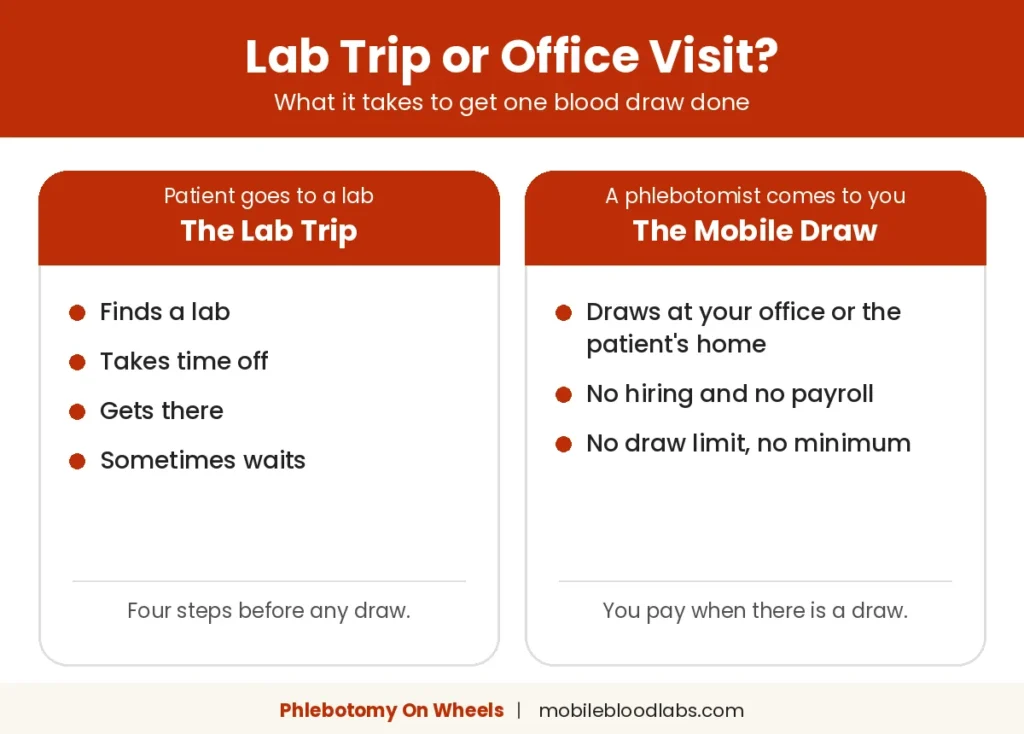
Patients skip blood draws because the draw is a separate errand. They have to pick a lab, find the time, get there and sometimes wait. The most reliable fix is to remove the errand: draw at your office, at the patient’s home or at a collection site by appointment, and send the specimen to the lab the order names.
The scale is bigger than most offices assume. In a 2026 Aflac survey of U.S. adults ages 18 to 65, roughly one in three said they avoid or delay blood tests, according to a November 2026 Medical Economics article by Web Golinkin.
Older research points the same way. A study in the Journal of General Internal Medicine followed 27,802 adults, average age 67, in one multispecialty group practice. They had been told to get lab tests to monitor their medicines. Depending on the medicine, between 0 and 24 percent of those tests were never done.
You probably recognize the reasons from your own waiting room: no time off work, no ride, a bad experience with a past draw, plain dread of needles. That last one is common. The same Medical Economics article cites a 2019 review that put needle fear at 20 to 50 percent of adolescents and 20 to 30 percent of young adults.
What a Skipped Draw Costs Your Practice
A skipped draw rarely announces itself. The order sits open. The follow up visit either gets pushed or goes ahead without results. Someone on your team spends part of a morning calling a patient who never went.
For patients on monitored medicines the stakes are clinical. In the study above, the highest skip rates, near 24 percent, were among patients on water pills who needed kidney and potassium checks.
Then there is the cost inside your own building. When your staff draws between patients, the schedule slips. A hard to find vein turns a quick task into a long one, and the next patient waits.
Four Ways Practices Handle Blood Draws
- Draw in house with your own staff. Fast for the patient, but it uses your team’s time and takes training and supplies.
- Send every patient to a lab. Simple for you, but it depends on the patient following through. This is where most skipped draws start.
- Hire a phlebotomist. Works when volume is steady. It is a fixed cost for work that rises and falls.
- Bring in a mobile phlebotomist for the draws you have. You pay when there is a draw.
Most practices end up using more than one. The real question is which draws should leave your hands.
Orders sitting open at your practice? Tell our team how many draws you send out, and we will come to your office or the patient.
Talk to Sales Schedule a MeetingWhat a Mobile Blood Draw Looks Like for Your Practice
You call to schedule a draw. A phlebotomist comes to your office at the time of the draw, draws the patient and drops the specimen at the lab the order names. It works for whichever laboratory your doctors use, so you do not need a separate arrangement for each lab. Your lab choice stays yours.
Draws can also happen at the patient’s home, or at our Patient Service Center in Columbia, Maryland, by appointment. Chain of custody follows the specimen the whole way, and draws are HIPAA compliant. Hard sticks and difficult veins are our job, so they do not hold up your day.
There is no limit on draws and no minimum to start, so a practice with a handful of draws a month and a group with hundreds can use the same service. Phlebotomy On Wheels draws blood only. We are not a lab, and we do not provide nurses, aides or doctors. For the full picture, see our page on mobile blood draw for clinics and doctors’ offices.
How to Decide Which Draws to Hand Off First
Start with a one week list. Write down every order that needs a blood draw and mark where it was drawn: in house, sent out, or not done.
The “sent out” and “not done” lines are the draws to move first. They are the ones costing you follow through. If most of your “not done” orders belong to older patients, patients with limited mobility or patients with long work days, those are the draws a home visit or an office visit solves best.
Keep the list for four weeks. It becomes your own number for how many orders never come back, which is more useful than any study.
Which Practices Get the Most From It
- Practices with patients who skip lab trips: older patients, patients with limited mobility and patients with busy work days.
- Small practices that cannot justify a full time phlebotomist.
- Group practices with patients spread across several labs.
- Offices where staff time between patients is the bottleneck.
If your draws are already handled smoothly in house, you may not need this. If orders are going missing, you probably do. Facilities such as nursing homes and home health agencies have a different setup, and our page for healthcare facilities covers it. If you are weighing outside options in general, how outsourced phlebotomy options compare walks through them.
Which option fits your facility
Frequently Asked Questions
Why do patients skip blood draws?
Because the draw is a separate errand: finding a lab, taking time off, getting there and sometimes waiting. Needle fear, transport problems and past bad experiences add to it. In a 2026 Aflac survey, about one in three U.S. adults ages 18 to 65 said they avoid or delay blood tests.
Can a doctor’s office use a mobile phlebotomist instead of hiring one?
Yes. A phlebotomist comes when you have a draw. There is no hiring, no payroll, no draw limit and no minimum to start.
Which labs do you draw for?
Whichever laboratory the order requires. We drop the specimen at the lab the order names. Phlebotomy On Wheels is not a lab.
Do you only draw at the clinic?
No. We can draw at your office, at the patient’s home, or at our Patient Service Center in Columbia, Maryland, by appointment.
Do you handle hard to find veins?
Yes. Hard sticks and difficult veins are part of the job.
Is this for small practices too?
Yes. Individual doctors, small practices and large groups are all welcome.
Are draws HIPAA compliant?
Yes. Draws are HIPAA compliant and follow chain of custody.
How often do patients skip ordered lab tests?
It depends on the test. In one study of 27,802 adults in a multispecialty group practice, between 0 and 24 percent of monitoring tests were never completed, depending on the medicine.
How do we schedule?
Call to schedule a draw, or schedule a meeting if you want to set up draws for a whole practice. Partnership questions: sales@mobilebloodlabs.com.
Related Articles
Sources
- Golinkin W. Why patients skip ordered blood tests and how practices can close the gap. Medical Economics, November 3, 2026.
- Fischer SH, Field TS, Gagne SJ, et al. Patient Completion of Laboratory Tests to Monitor Medication Therapy: A Mixed-Methods Study. Journal of General Internal Medicine, 2013.
Orders sitting open at your practice? Tell our team how many draws you send out, and we will come to your office or the patient.
Talk to Sales Schedule a Meeting