
Is Therapeutic Phlebotomy Medically Supervised? What To Expect

Getting a verbal order from a doctor for therapeutic phlebotomy is one thing. Knowing exactly what therapeutic phlebotomy medical supervision looks like once someone shows up to do the draw is another.
Whether it’s done under medical supervision, how much blood actually comes out, how long a session takes, and whether it’s safe outside a hospital or infusion center. These are the real questions, especially for a treatment that involves removing a measurable amount of blood on a repeating schedule.
Here’s what it actually looks like in practice, and whether it’s done under medical supervision the way people assume, plus everything else people ask.
Medical Disclaimer: This article is for educational purposes only and is not medical advice. Always consult your physician about whether therapeutic phlebotomy is right for your condition.
What Is Therapeutic Phlebotomy?
Therapeutic phlebotomy is the controlled removal of blood, typically about a pint at a time, to treat a specific medical condition rather than to collect a sample for lab testing. It’s most commonly prescribed for hemochromatosis, a condition where the body absorbs and stores too much iron, and for polycythemia vera, a condition where the body produces too many red blood cells. Removing blood on a physician directed schedule lowers iron stores or red blood cell volume back toward a safe range. Cleveland Clinic, What Is Therapeutic Phlebotomy?
Unlike a standard blood draw for lab work, therapeutic phlebotomy exists because the removal itself is the treatment.
Therapeutic Phlebotomy Medical Supervision: What Actually Happens
Yes. Every therapeutic phlebotomy appointment is performed under the same medical oversight standards used in a hospital or infusion center. A certified phlebotomist follows the volume and schedule set by the patient’s physician, monitors the patient throughout the draw, and documents the procedure for the ordering provider. A verbal order from the physician confirms the treatment plan before the appointment ever begins, no written prescription required.
This is medical supervision in the form that actually matters for a mobile appointment: a physician sets the plan, a certified professional executes it exactly as ordered, and the results are reported back. NIDDK, Hemochromatosis Treatment confirms this is the standard approach, describing regular, physician directed blood removal as “the most direct and safe way to lower body stores of iron.”
What Happens During A Therapeutic Phlebotomy Session
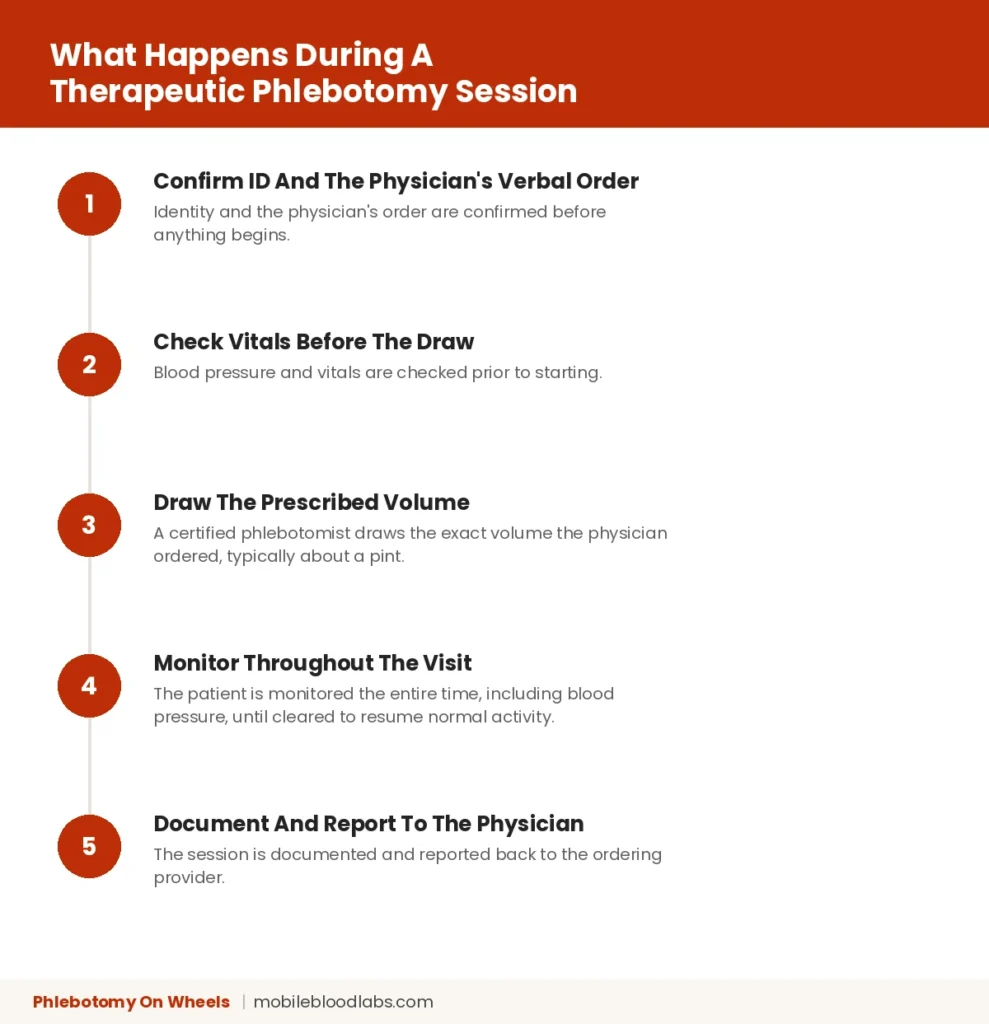
A session typically takes 15 minutes to an hour, depending on the amount of blood being removed and the patient’s individual health status. Cleveland Clinic, What Is Therapeutic Phlebotomy?
The process itself:
- Confirming identity and the physician’s verbal order
- Checking vitals before the draw begins
- Preparing sterile, single use equipment
- Drawing the prescribed volume of blood
- Monitoring the patient throughout, including blood pressure
- Confirming the patient feels well before clearing them to resume normal activity
- Documenting the procedure and reporting back to the ordering physician
Every step follows OSHA’s Bloodborne Pathogens Standard (29 CFR 1910.1030), the same federal safety requirement that governs blood collection in any clinical setting, hospital or home.
How Much Blood Is Removed During Therapeutic Phlebotomy?
Most sessions remove one unit of blood, the same as a standard pint, roughly 450 to 500 milliliters. A physician may adjust this amount up or down based on the patient’s condition, lab values, and how they’ve tolerated previous sessions. NIDDK, Hemochromatosis Treatment
Is A Doctor Or Nurse Physically Present During The Visit?
The physician doesn’t need to be in the room for the draw itself, that’s what the verbal order establishes ahead of time. What matters is that a certified phlebotomist, trained specifically for therapeutic draws and following the physician’s exact instructions on volume and schedule, is present and monitoring the patient for the entire appointment. Anything outside the plan gets reported back to the ordering physician directly.
Is Therapeutic Phlebotomy Safe To Do At Home?
Yes, when it’s performed by a certified phlebotomist following a physician’s order and using the same safety protocols required in a clinical setting. The equipment, technique, and monitoring don’t change based on location, only where the appointment happens does. Patients with more complex medical needs should always confirm with their physician that an at home appointment is appropriate for their specific situation.
How Often Can Therapeutic Phlebotomy Be Repeated?
This is set entirely by the ordering physician, not a fixed schedule. Early in treatment, sessions can be as frequent as weekly, especially for newly diagnosed hemochromatosis. Once iron stores or red blood cell counts reach a target range, most patients move to a maintenance schedule, often just a few times a year. NIDDK, Hemochromatosis Treatment
Do You Need A Doctor’s Referral For Therapeutic Phlebotomy?
A verbal order from a physician is required, but a formal written prescription is not. On the first call, the physician’s order gets confirmed directly with the provider before the appointment is scheduled, no separate referral paperwork needed on the patient’s end.
How Therapeutic Phlebotomy Compares To Donating Blood
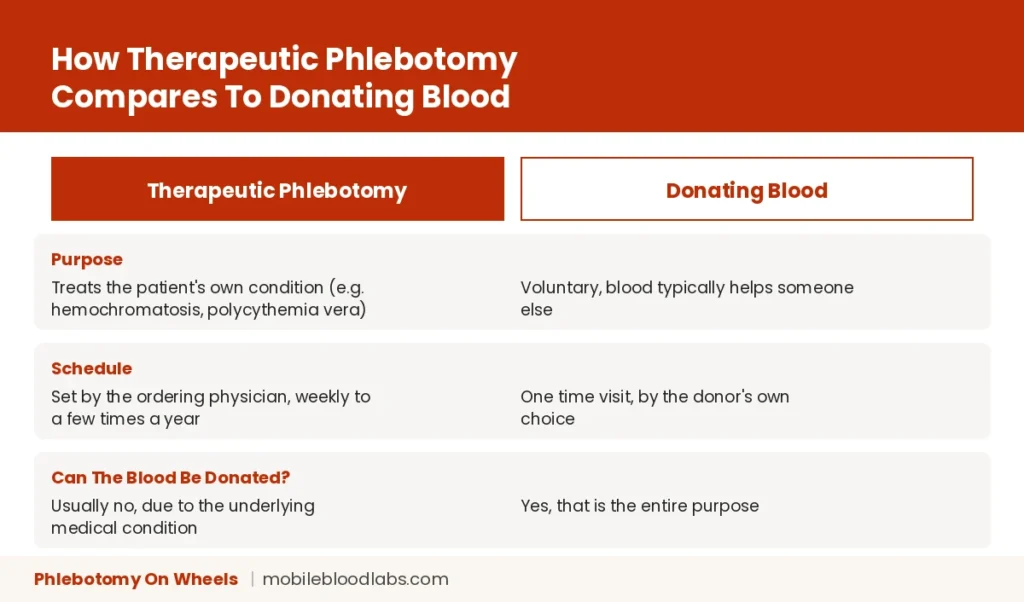
Both remove a similar volume of blood, but the purpose and process are different. Blood donation is voluntary and the blood is typically used to help someone else. Therapeutic phlebotomy is prescribed to treat the patient’s own condition, follows a physician directed schedule rather than a one time visit, and in most cases the blood removed cannot be used for donation due to the underlying medical condition. Patients should always confirm with their provider whether their specific situation allows for blood donation instead of, or alongside, therapeutic phlebotomy.
Therapeutic Phlebotomy In Maryland
Maryland patients get the same medically supervised process described above, whether that’s at home, at work, or at a care facility, plus a walk in option with same day availability common. See our Patient Service Center page for hours and location, or Therapeutic Phlebotomy for nationwide coverage.
Pricing starts at $100, though the final cost depends on your location. Call (443) 866-3647 for an exact quote. For a full breakdown, see Therapeutic Phlebotomy Cost: What Patients Actually Pay. This is a convenience based service and is not covered by insurance.
For patients managing high hemoglobin specifically, see Therapeutic Phlebotomy For High Hemoglobin for a condition specific breakdown.
Call (443) 866-3647 To Schedue A Medically Supervised Appointment
Key Takeaways
- Yes, therapeutic phlebotomy is done under medical supervision, a certified phlebotomist follows a physician’s exact order on volume and schedule, and monitors the patient throughout
- A physician’s order is required, written or verbal, either one works
- Most sessions remove one unit of blood, about a pint, in 15 minutes to an hour
- Frequency is set entirely by the ordering physician, from weekly early in treatment to a few times a year for maintenance
- The same safety protocols apply whether the appointment happens at home, at work, or at a care facility
- Therapeutic phlebotomy and blood donation both remove blood, but only one is prescribed to treat the patient’s own condition
Frequently Asked Questions
A. Yes. Every appointment is performed under the same medical oversight standards used in a hospital or infusion center. A certified phlebotomist follows the physician’s prescribed volume and schedule, monitors the patient throughout, and documents the procedure for the provider.
A. A physician’s order is required, and either works. If you already have a written prescription, that’s accepted. If not, a verbal order from your doctor is fine too.
A. Typically one unit, about a pint or 450 to 500 milliliters, adjusted based on the patient’s condition and how they’ve tolerated previous sessions.
A. 15 minutes to an hour, depending on the volume being removed and the patient’s individual health status.
A. A certified phlebotomist trained specifically for therapeutic draws is present and monitoring throughout, following the physician’s exact order. The physician doesn’t need to be in the room, that’s what the verbal order establishes in advance.
A. Yes, when performed by a certified phlebotomist following a physician’s order and using the same safety protocols required in a clinical setting.
A. Set by the ordering physician, not a fixed schedule. Early treatment can be as frequent as weekly, moving to a maintenance schedule of a few times a year once target levels are reached.
A. Both remove a similar amount of blood, but therapeutic phlebotomy is prescribed to treat the patient’s own condition on a physician directed schedule, while donation is voluntary and the blood is typically used to help someone else.
A. Appointments start at $100, though final pricing depends on frequency and location. Call (443) 866-3647 to get your exact quote.
A. No, this is a convenience based, self pay service.
Related Reading
- Therapeutic Phlebotomy For High Hemoglobin
- Therapeutic Phlebotomy Cost: What Patients Actually Pay
- Therapeutic Phlebotomy In Maryland
2 Responses