
What Are Standing Orders for Lab Work?

If you’ve booked the same lab test three months in a row and felt the frustration of starting from scratch every time, standing orders for lab work solve exactly that problem. A standing order is a written instruction from your doctor that authorizes the same blood test to be repeated on a set schedule, without a new order signed every single visit. Instead of booking one test, then going back to your doctor for another order, then booking again, a standing order covers multiple visits under one approval.
What Does Standing Orders Mean for Lab Work?
Standing orders for lab work are a written instruction from your doctor that authorizes the same blood test to be repeated on a set schedule, without you needing a new order signed every single time. Instead of booking one test, then going back to your doctor for another order, then booking again, a standing order covers multiple visits under one approval.
This term shows up most often for patients managing chronic conditions. If your doctor wants to track your blood sugar monthly, your iron levels every few weeks, or your kidney function on a quarterly basis, a standing order makes that recurring testing simple to schedule.
According to the U.S. National Library of Medicine, lab tests are often ordered to monitor a disease or check if treatment is working, and standing orders are the tool that makes ongoing monitoring practical instead of repetitive.
How Standing Orders for Lab Work Actually Work
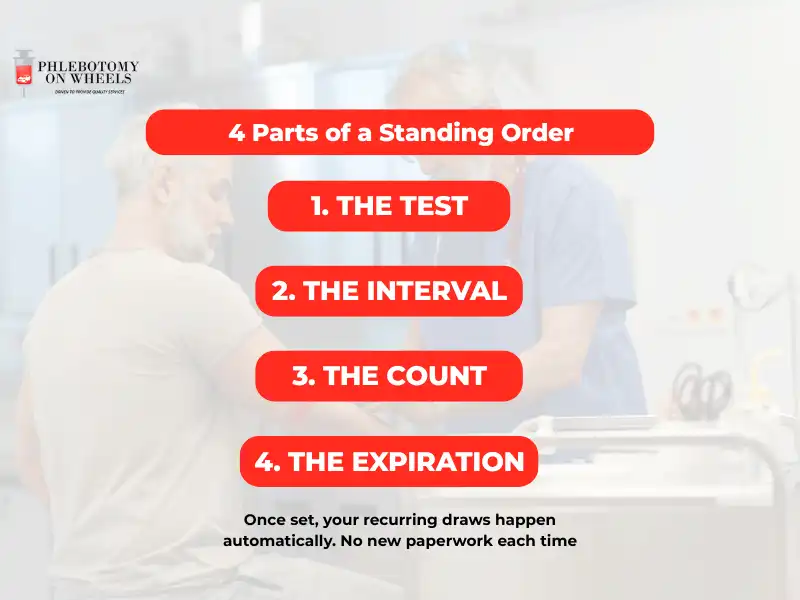
A standing order typically includes four key pieces of information your doctor must specify:
The exact test or tests: For example, a basic metabolic panel or HbA1c test.
The interval: How often the test should be repeated, such as monthly or every 90 days.
The number of times: How many total instances the order covers before it needs renewal.
The expiration date: Most standing orders are valid for a defined period, often up to a year, after which your doctor must reissue the order.
Each time you go for your scheduled blood draw, the lab or phlebotomist confirms the standing order is still active, draws your sample, and sends results to your doctor, no new paperwork required from you.
Who Typically Needs Standing Orders for Lab Work?
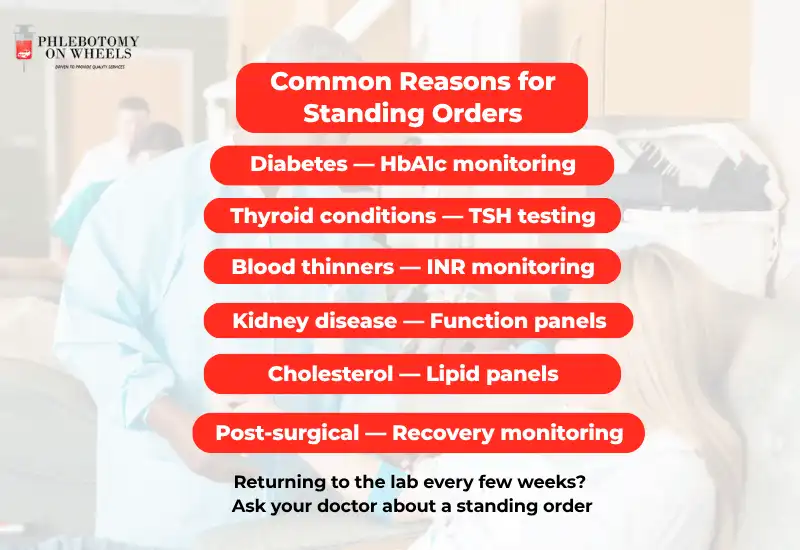
Standing orders are most common for patients managing ongoing health conditions that require regular monitoring:
- Diabetes management: Regular HbA1c and glucose monitoring
- Thyroid conditions: Periodic TSH testing to adjust medication
- Blood thinner monitoring: INR testing for patients on warfarin
- Kidney disease: Regular creatinine and kidney function panels
- Cholesterol management: Periodic lipid panels while on statin therapy
- Post-surgical recovery: Short-term repeated testing to monitor healing
- Hemochromatosis: Regular monitoring alongside therapeutic phlebotomy treatment
If you find yourself returning to the lab for the same test every few weeks or months, a standing order is worth asking your doctor about.
Standing Orders vs. a New Order Every Time
| Standing Order | New Order Each Time | |
| Doctor visit needed each time | No | Often yes |
| Scheduling effort | One setup, then repeat | Repeated booking process |
| Best for | Predictable, recurring testing | One-off or changing tests |
| Paperwork | Signed once, covers multiple visits | Signed for every visit |
The tradeoff is flexibility. A new order each time lets your doctor adjust testing based on your most recent results. A standing order works best when the testing schedule itself is already predictable and unlikely to change.
Does Medicare Cover Standing Orders for Lab Work?
This is where it helps to be precise, because the rules are stricter than many patients expect.
According to an official Medicare Administrative Contractor fact sheet, Medicare does not accept a standing order as proof of medical necessity on its own. Each test under a standing order must still meet specific conditions to be reimbursed:
- The test must be appropriate and necessary for that specific patient on that specific date
- The frequency of testing must not exceed what is medically necessary
- The diagnosis must be clearly documented for each test
- Your treating physician must review each result and adjust the order if needed
In plain terms: Medicare will cover the recurring tests under your standing order, but only if your doctor continues to document medical necessity for each instance, not simply because the order exists. This is a compliance detail handled between your doctor’s office and Medicare, not something you need to manage yourself, but it’s worth understanding so you know why your doctor’s office may periodically confirm your diagnosis is still current.
For Medicaid and private insurance, coverage rules vary by state and by plan. Always confirm with your specific provider.
How to Set Up Standing Orders for Lab Work
Setting up a standing order is a conversation with your doctor, not something you arrange directly with a lab. Here is the typical process:
Step 1: Ask your doctor directly. If you’re managing a chronic condition with recurring labs, ask whether a standing order makes sense for your situation.
Step 2: Your doctor documents the order. This includes the test, interval, duration, and your diagnosis.
Step 3: The order is sent to your lab or testing provider. This can be faxed, mailed, or sent electronically depending on your provider’s system.
Step 4: You schedule your recurring draws. Once the standing order is on file, each subsequent blood draw can be booked without re-confirming the order from scratch.
Step 5: Your doctor reviews results and renews as needed. Most standing orders require periodic renewal, often annually.
Standing Orders for Lab Work With Mobile Blood Draws

One of the most practical applications of a standing order is pairing it with a mobile blood draw service. Once your standing order is set up with Phlebotomy On Wheels, your recurring blood draws can happen at home, at work, or at a care facility, on the same predictable schedule your doctor ordered, without coordinating a new appointment booking every single time.
This is particularly useful for patients managing conditions that require frequent monitoring but who also face mobility challenges, busy schedules, or simply prefer not to make repeated trips to a lab. For more on how mobile scheduling works for ongoing care, see our guide on mobile phlebotomy for seniors and homebound patients.
Our certified phlebotomists coordinate directly with your ordering physician’s office to confirm your standing order is active before each scheduled visit, so there’s no gap in your monitoring and no surprise paperwork at your door.
For pricing on routine and recurring draws, see our mobile phlebotomy cost guide.
Frequently Asked Questions
A standing order for lab work is a written instruction from your doctor authorizing the same blood test to be repeated on a set schedule, without needing a new signed order for every individual visit.
This varies by provider and by state regulation, but standing orders commonly last up to 12 months before requiring renewal. Your doctor’s office manages the renewal timeline.
Coverage depends on your specific insurance and the medical necessity documentation behind each test. Medicare requires that each test under a standing order still meets individual medical necessity criteria, the order itself does not guarantee coverage. Confirm with your provider for specifics on your plan.
You can ask your doctor whether a standing order is appropriate for your situation, but the order itself must be written and authorized by your physician, it is not something you can set up independently with a lab.
Yes. Once your doctor’s office has issued a standing order, mobile phlebotomy providers like Phlebotomy On Wheels can coordinate with that order to schedule your recurring blood draws at home or another convenient location.
Once a standing order reaches its expiration date or completes its specified number of instances, your doctor must review your case and issue a new order if continued testing is still needed.
Set Up Your Standing Order Today
Managing recurring lab work shouldn’t mean repeated booking and coordination every time. Once your doctor has issued your standing order, our certified phlebotomists handle the rest, scheduled visits, on time, wherever you need them.
Schedule Your Standing Order Blood Draw →
Related services:
- Standing Orders — Set up recurring lab testing
- Routine Blood Draws — Standard scheduled visits
- Therapeutic Phlebotomy — Medically directed treatment
- Mobile Phlebotomy for Seniors — Recurring care for homebound patients
Sources & Citations
- CGS Medicare — Lab Services/Orders Fact Sheet
- MedlinePlus — How to Prepare for a Lab Test (U.S. National Library of Medicine)
This article is for educational purposes only and does not constitute medical or legal advice. Coverage and documentation requirements vary by insurer and state, always confirm with your provider.
GET IN TOUCH
Book Your Appointment Now
Staying current on mobile phlebotomy referrals and lab coordination is easier than you think. Subscribe to Mobile Phlebotomy Insider — our bi-weekly newsletter built specifically for healthcare providers, clinics, and senior living facilities navigating mobile draws and staffing solutions. Practical insights delivered directly to your LinkedIn inbox, every other Tuesday.
2 Responses