
Understanding Mobile Phlebotomy Pricing
Wondering how much actually mobile phlebotomy cost in 2026?
If you’re considering at-home blood testing instead of visiting a clinic, your first question is usually simple: “How much is this going to cost me?”
The good news is that mobile phlebotomy is often more affordable than most people expect, especially when insurance coverage is involved. Medicare covers clinical laboratory services at NO COST for eligible patients, and Medicaid typically covers the service with little to no copay.
But pricing can vary significantly based on your insurance type, location, and the tests you need. That’s why we created this comprehensive guide.
In this article, we break down everything you need to know about mobile phlebotomy pricing, including:
- Average cost per visit in 2026 (broken down by service type)
- Insurance, Medicare, and Medicaid coverage (state-by-state variations)
- Cost by specific blood test types (CBC, metabolic panels, etc.)
- What affects pricing (and what doesn’t)
- How to reduce your out-of-pocket cost (legitimate strategies)
- Mobile phlebotomy vs other testing options (real cost comparison)
By the end, you’ll know exactly what to expect before booking an at-home blood draw—and you’ll understand why so many patients choose this option over traditional labs.
Medical Disclaimer: This article is for educational purposes only. Always consult with your healthcare provider about your specific lab testing needs and insurance coverage. Pricing information is current as of May 2026 and may vary by location and provider. For 2026-specific rates, visit Medicare.gov and your state’s Medicaid website.
What Is the Average Mobile Phlebotomy Cost in 2026?
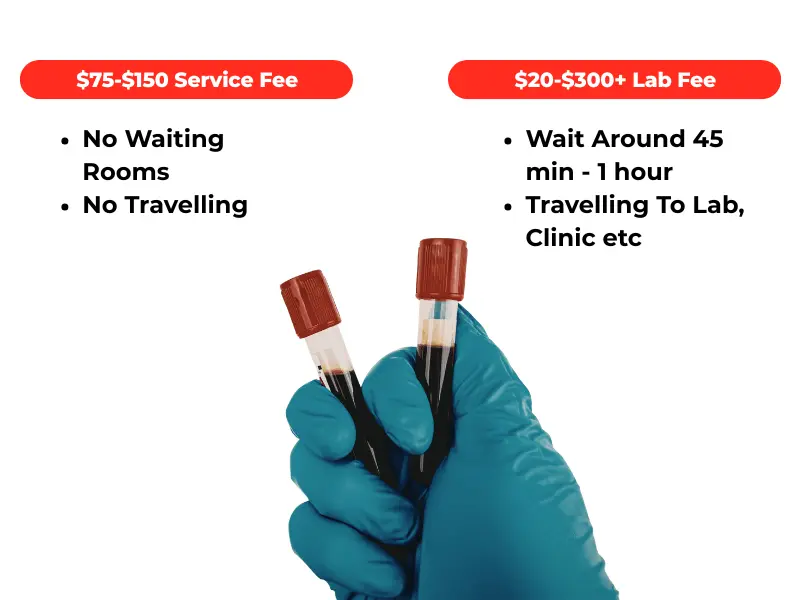
Mobile phlebotomy typically costs between $75–$150 per visit (service/collection fee only). Our routine blood draw services are available for standard testing needs.
This fee covers:
- Professional phlebotomist travel to your home, office, or preferred location
- Blood sample collection using sterile, approved techniques
- Proper specimen handling and labeling for accuracy
- Safe transportation to the designated laboratory
- Documentation and chain-of-custody procedures
But here is the critical distinction most people misunderstand:
This is NOT the full cost of your blood test.
You are actually paying for two completely separate services:
Collection/Service Fee (Mobile Visit)
- Cost: $75–$150
- What includes: Phlebotomist time, travel, specimen collection
- Who pays: You pay upfront or insurance covers (sometimes)
Laboratory Testing Fee (Processing & Analysis)
- Cost: $20–$300+ depending on tests ordered
- What includes: Lab processing, analysis, results interpretation
- Who pays: Insurance typically covers this (if medically necessary)
The Real Total Cost Formula:
Your Out-of-Pocket Cost = (Collection Fee – Insurance Coverage) + (Lab Fees – Insurance Coverage)
Example Scenarios:
Scenario 1: Medicare Patient (Homebound)
- Collection fee: $100 (coverage varies by provider agreement)
- Lab testing: $150 (Medicare covers clinical laboratory services at no cost)
- Your total: $0–$100 (depending on provider arrangement)
Scenario 2: Private Insurance Patient
- Collection fee: $95 (Insurance doesn’t cover, you pay $95)
- Lab testing: $120 (Insurance covers based on plan, you pay copay)
- Your total: $95–$119 (depending on plan details)
Scenario 3: Uninsured Patient
- Collection fee: $100 (you pay full)
- Lab testing: $180 (you pay full)
- Your total: $280
Mobile Phlebotomy Cost by Insurance Type
Here’s how your insurance specifically affects what you’ll actually pay:
Medicare Part B Coverage
According to Medicare.gov, Medicare Part B covers:
Clinical Laboratory Services: $0 (no cost to patient)
- Blood tests and laboratory services are covered at NO COST for eligible patients
- This includes tests ordered by your physician for medically necessary reasons
Home Health Care Services: $0 (no cost to patient)
Your doctor must order the service and certify homebound status
Medicare covers home health care services at NO COST for eligible homebound patients
What you need to know:
- Homebound Eligibility Required: Your doctor must certify you’re unable to leave home without significant assistance
- Doctor’s Order Required: Labs must be ordered by your physician
- Coverage for Clinical Lab Services: $0 (fully covered for eligible patients)
- Coverage for Home Health Care: $0 (fully covered for eligible homebound patients)
- Durable Medical Equipment: 20% of Medicare-approved amount (wheelchairs, walkers, hospital beds, etc.)
Qualifying Situations for Homebound Status:
- Mobility limitations or disability
- Post-surgical recovery
- Chronic illness requiring frequent monitoring
- Advanced age with transportation barriers
- Recent hospitalization
Important: While Medicare covers the clinical lab services and home health care at $0, the collection fee charged by the mobile phlebotomy company may vary. Ask your provider if they bill Medicare directly or if you’ll need to pay upfront and seek reimbursement.
Medicaid Coverage (State-by-State)
According to Medicaid.gov, Medicaid typically covers mobile phlebotomy with little to no copay ($0–$15), though coverage varies by state. For families with children needing blood work, our pediatric blood draw services include child-friendly techniques and comfort measures.
Key Point: Medicaid coverage is NOT uniform across the United States. Your state Medicaid program may have different rules.
Common State Examples:
| State | Coverage Status | Typical Copay | Key Requirements |
| California | Generally covered | $0 | Medically necessary, provider approved |
| Texas | Generally covered | $5 | Homebound/mobility issue + doctor order |
| Florida | Generally covered | $0-$5 | Must be Medicaid recipient, approved provider |
| New York | Generally covered | $0 | For seniors and disabled individuals |
| Pennsylvania | Generally covered | $3-$5 | Doctor-ordered, medical necessity |
| Ohio | Generally covered | $0-$2 | Homebound elderly or disabled |
| Illinois | Generally covered | $5 | Frequent testers, chronic conditions |
NOTE: These amounts are examples and may change in 2026. Always verify current rates with your state’s Medicaid program.
How to Check Your State’s Coverage:
- Visit your state’s Medicaid website (e.g., “Texas Medicaid” or “California Department of Health Care Services”)
- Search for “mobile phlebotomy,” “home health services,” or “home-based blood draw”
- Call your Medicaid caseworker for specific plan details and 2026 rates
- Ask your mobile phlebotomy provider if they’re a Medicaid-approved vendor in your state
Pro Tip: Most state Medicaid programs cover mobile lab services when ordered by a physician, but you must use a Medicaid-approved provider.
Private Insurance Coverage
Private insurance may cover mobile phlebotomy with pre-authorization, with typical copays ranging from $10–$50 (varies significantly by plan).
How Private Insurance Works:
- Pre-Authorization Usually Required: Call your insurance before booking
- In-Network vs Out-of-Network: In-network providers cost less
- Copay Range: $10–$50 (varies by plan)
- Lab Tests: Usually fully covered for medically necessary reasons
- Billing: Many mobile providers are out-of-network (you pay, then submit for reimbursement)
Common Scenarios:
Scenario A: Well-Covered Plan
- Copay: $15
- Lab tests: 80% covered
- You submit claim: Reimbursement received in 2-4 weeks
Scenario B: High-Deductible Plan
- Service fee: Counts toward deductible
- Lab tests: Counts toward deductible
- Total out-of-pocket: May be $200–$500 until deductible met
Money-Saving Tip: Ask your mobile phlebotomy provider if they:
- Bill insurance directly (saves you hassle)
- Are in-network with your plan (saves money)
- Offer discounts for upfront payment
Self-Pay Pricing (No Insurance)
Without insurance, expect to pay $60–$150 for the service fee plus lab processing costs.
Actual Cost Breakdown:
- Service Fee: $75–$150
- Lab Processing (varies by test):
- Basic tests (CBC, metabolic panel): $30–$80
- Specialty tests (thyroid, hormone panels): $50–$150
- Multiple tests bundled: $100–$250
- Possible Rush Fee: +$15–$30 (if same-day needed)
Realistic Self-Pay Total: $150–$350 for a routine appointment with 2–3 tests
Mobile Phlebotomy Cost Breakdown by Test Type
Different blood tests have different lab processing costs. Here’s what you can expect:
Common Routine Tests (Low Cost)
| Test | What It Measures | Lab Cost | Mobile Fee | Total |
| CBC | Complete Blood Count (red/white cells, platelets) | $15–$40 | $75–$150 | $90–$190 |
| Metabolic Panel | Kidney/liver function, glucose, electrolytes | $25–$75 | $75–$150 | $100–$225 |
| Lipid Panel | Cholesterol, triglycerides, HDL/LDL | $30–$60 | $75–$150 | $105–$210 |
Moderately Priced Tests
| Test | What It Measures | Lab Cost | Mobile Fee | Total |
| TSH/Thyroid | Thyroid function | $20–$50 | $75–$150 | $95–$200 |
| A1C (Diabetes) | 3-month average blood sugar | $10–$35 | $75–$150 | $85–$185 |
| Vitamin D | Vitamin D deficiency screening | $25–$50 | $75–$150 | $100–$200 |
Higher-Cost Specialty Tests
| Test | What It Measures | Lab Cost | Mobile Fee | Total |
| Thyroid Panel (Full) | TSH, T3, T4, antibodies | $50–$150 | $75–$150 | $125–$300 |
| Hormone Panel | Testosterone, estrogen, progesterone | $75–$200 | $75–$150 | $150–$350 |
| Genetic Testing | DNA analysis for hereditary conditions | $200–$500+ | $75–$150 | $275–$650+ |
Smart Strategy: If you need multiple tests, bundle them in one appointment. One $100 service fee covers 5 different tests, not five $100 fees.
What Affects Mobile Phlebotomy Pricing?
Pricing is NOT fixed. Several factors influence what you’ll actually pay:
1. Geographic Location (BIGGEST Factor)
One of the biggest factors affecting cost is the geographic location, with urban areas typically having higher prices due to increased demand and operating expenses, while rural areas may offer more affordable options.
Location Price Ranges:
- Major Cities (NYC, LA, Chicago): $100–$150+ service fee
- Suburbs: $85–$115 service fee
- Rural Areas: $75–$95 service fee
- Remote Areas: May add travel surcharge ($25–$50)
Why the difference? Urban providers have higher overhead costs, more demand, and higher operating expenses.
2. Time of Visit
Standard Hours (Monday–Friday, 8am–5pm)
- Standard pricing applies
- Fastest turnaround
- Most convenient for patient
Off-Hours Charges:
- Evenings (after 5pm): +$15–$25
- Weekends: +$20–$40
- Holidays: +$25–$50
- Same-day emergency: +$30–$75
Need urgent results? Our STAT draw services are available for testing needs.
3. Number of Tests/Complexity
- 1–2 tests: Standard fee
- 3–5 tests: Often bundled (1 fee for all)
- 6+ tests: Sometimes negotiable rates
- Complex tests (genetic, specialty): May add $25–$50
4. Provider Type
The reputation and experience of the Mobile Phlebotomy provider can impact pricing, with established companies charging more than newer or lesser-known providers.
| Provider Type | Typical Cost | Pros | Cons |
| Independent Phlebotomist | $75–$100 | Cheaper, personal service | Less infrastructure |
| Independent Phlebotomist | $85–$120 | Reliable, regional network | Medium pricing |
| National Chain | $110–$150 | Extensive network, consistent | Higher overhead |
| Hospital-Affiliated | $90–$130 | Direct integration | Limited areas |
Money-Saving Tip: Independent phlebotomists often cost 20–30% less than national chains while providing identical quality.
5. Insurance Network Status
- In-Network Provider: Insurance covers portion, you pay copay
- Out-of-Network Provider: You pay full amount, claim reimbursement yourself
- Direct Bill: Provider bills insurance directly (saves you paperwork)
Mobile Phlebotomy vs Traditional Lab: Real Cost Comparison

How does mobile phlebotomy actually compare to traditional labs and other testing options?
Cost Comparison Chart
| Factor | Mobile Phlebotomy | Traditional Lab | Mail-In Kit | Telehealth + Lab |
| Service Fee | $75–$150 | $0–$20 | $49–$200 | $0–$50 |
| Your Travel Cost | $0 (they come to you) | $5–$30 | $0 (mailed to home) | $5–$30 (if follow-up) |
| Your Time Cost | Minimal (15–30 min) | 1–3 hours (travel + wait) | 5 min (swab at home) | 30–60 min |
| Insurance Coverage | Usually partial | Usually full | Variable | Usually partial |
| Accuracy | Same as lab | Lab standard | Lab standard | Lab standard |
| Result Speed | 24–48 hours | 24–48 hours | 3–7 days | 2–5 days |
| Comfort Level | Very high | Moderate | High | Moderate |
| For Mobility Issues | Excellent | Poor | Good | Moderate |
| For Chronic Disease Monitoring | Excellent | Good | Fair | Good |
The Real Cost When You Factor Everything In
Traditional Lab Visit:
- Service fee: $0
- Drive time: 30 minutes + gas ($5)
- Parking: $5
- Wait time: 1 hour (unpaid labor @ $25/hr = $25)
- Total True Cost: $35 + time burden
Mobile Phlebotomy:
- Service fee: $100 (insurance may cover)
- Travel time: 0 (you save 30 min + gas)
- Wait: 0 (appointment-based)
- Total True Cost: $100 (or $20–$75 with insurance)
The Hidden Value of Mobile Phlebotomy:
- For chronic disease: Enables consistent monitoring
- For working professionals: Saves 1–2 hours
- For seniors: Eliminates fall/injury risk during travel
- For homebound: Only option for regular testing
Here are legitimate strategies to reduce your out-of-pocket costs:
1. Verify Insurance Coverage BEFORE Booking
Call your insurance company before scheduling:
- Ask specifically: “Does my plan cover mobile phlebotomy?”
- Ask: “Do I need pre-authorization?”
- Ask: “What’s my copay?”
- Ask: “Are there in-network mobile phlebotomy providers?”
Time Saved: 5 minutes | Money Saved: $25–$75 (avoiding surprise costs)
2. Bundle All Tests Into One Visit
Instead of scheduling 3 separate appointments:
- 3 separate visits = 3 × $100 = $300
- 1 combined visit = $100 (for all tests)
- Savings: $200
Work with your doctor to order all needed tests at once.
3. Book During Standard Hours
Avoid evening/weekend/holiday surcharges:
- Standard hours (9am–5pm, weekdays): $100
- After 5pm: $125
- Weekends: $140
- Savings: $25–$40 per visit
4. Use an Independent Phlebotomist
Large chains charge more due to overhead. Independent providers often:
- Charge 20–30% less
- Provide the same quality
- Offer personalized service
- May negotiate bundled pricing
How to find them:
- Ask your doctor for referrals
- Search “[your city] independent phlebotomist”
- Check local healthcare directories
5. Use HSA/FSA Funds (Pre-Tax Savings)
Mobile phlebotomy is an eligible HSA/FSA expense when ordered by a physician.
How it works:
- You use pre-tax healthcare funds
- Effectively saves you 20–30% in taxes
- No additional cost, just better financial strategy
- Keep receipts for documentation
Example: $100 service fee + $100 lab test
- Regular payment: $200
- HSA payment: $200 (saves ~$60 in taxes)
6. Ask About Package Deals for Frequent Testing
If you need regular monitoring (diabetes, heart disease, etc.):
- Quarterly bundles: Save 15–25%
- Annual packages: Save 20–30%
- Monthly subscriptions: Often discounted rates
Ask your provider: “Do you offer discounts for recurring appointments?”
7. Check for Medicaid/Medicare Eligibility
- If you’re 65+: Check Medicare Part B
- If you’re low-income: Check your state’s Medicaid
- If disabled: Check both programs
Coverage could reduce your cost to $0 for clinical laboratory services.
Is Mobile Phlebotomy Covered by Insurance?
The short answer: Yes, usually—but with conditions.
Coverage depends on:
- Medical Necessity (not just convenience)
- Physician Order (must be doctor-ordered)
- Insurance Type (Medicare, Medicaid, private)
- Your Specific Condition (chronic disease = better coverage)
Most Common Coverage Scenarios
COVERED:
- Chronic disease monitoring (diabetes, heart disease, kidney disease)
- Post-hospital follow-up testing
- Doctor-ordered routine physical labs
- Homebound Medicare patients (with qualifying conditions)
- Frequent testing for medication monitoring
USUALLY NOT COVERED:
- Wellness/convenience-only bloodwork
- Self-directed testing (not doctor-ordered)
- Optional screening with no medical reason
- Employer wellness (varies by company)
How to Get Your Insurance to Cover It
Step 1: Get Doctor’s Order
- Schedule appointment with your doctor
- Ask: “Can you order mobile phlebotomy at home?”
- Get written order/requisition
Step 2: Check Insurance Requirements
- Call insurance: “Does my plan cover home phlebotomy?”
- Ask if pre-authorization needed
- Get insurance authorization number (if required)
Step 3: Choose Approved Provider
- Ask insurance: “Which mobile phlebotomists are in-network?”
- Or choose any provider and submit claim yourself
- If out-of-network, you may get reimbursed
Step 4: Verify Coverage Before Booking
- Confirm copay amount
- Confirm any restrictions
- Ask about lab billing (separate from collection fee)
Does Insurance Bill Directly or Do I Pay and Claim?
This is crucial to understand:
Two Common Billing Scenarios
Scenario 1: Direct Billing (Less Common)
- Mobile provider bills insurance directly
- You pay only copay at time of visit
- Insurance pays provider directly
- Easiest for you
Who does this: Large national chains, hospital-affiliated services
Scenario 2: Out-of-Network (More Common)
- You pay full fee at time of visit ($75–$150)
- Provider gives you receipt/invoice
- You submit to insurance yourself
- Insurance reimburses you 2–4 weeks later
Who does this: Independent phlebotomists, many regional providers
Pro Tip: Ask Your Provider
When booking, specifically ask:
- “Do you bill [My Insurance Name] directly?”
- “What’s your out-of-network reimbursement rate?”
- “Can you provide itemized receipt for insurance claim?”
- “Do you accept FSA/HSA cards?”
Frequently Asked Questions About Mobile Phlebotomy Costs
Yes. Medicare Part B covers clinical laboratory services (blood tests) at $0 cost and covers home health care services at $0 cost for eligible homebound patients. Your doctor must order the service and you must meet homebound criteria (unable to leave home without significant assistance).
Note: While the lab services are covered at no cost, collection fees charged by mobile phlebotomy companies may vary. Check with your provider about their billing practices.
A: Yes. Mobile phlebotomy is an eligible healthcare expense when ordered by a physician. Mobile phlebotomy is an eligible HSA and FSA expense.
Keep your receipts and claim forms for documentation.
A: You’re paying for:
- Professional travel (gas, time)
- Personalized appointment (no waiting in clinic)
- Your convenience (saved time and transportation)
- Premium service (phlebotomist comes to you)
Think of it like the difference between going to a restaurant vs having food delivered—the convenience costs extra.
A: Yes, absolutely. Mobile blood draw results are just as accurate as traditional lab draws because the same laboratory processes the samples, and mobile phlebotomists use identical equipment and procedures per professional standards.
The only difference is the location of collection. Once samples reach the lab, they’re processed identically to any other blood sample.
A: Results timing depends on the specific tests ordered, typically 24-48 hours for routine tests and 3-7 days for specialized testing.
Some tests are faster (CBC results in 12–24 hours) while others take longer (genetic testing can take 1–2 weeks).
A: Not typically. The lab needs time to process samples. However:
- Rush processing: Available from some labs (+$25–$50 fee)
- Some routine tests (rapid glucose, rapid strep): Same-day possible
- Most tests: 24–48 hours standard
Ask your provider about rush options if timing is critical.
A: To reduce out-of-pocket costs, use an independent phlebotomist instead of a national service, schedule during business hours, bundle multiple tests in one visit, and ask about self-pay discounts.
Typical self-pay costs:
- Service fee: $75–$100
- Lab tests: $30–$150 depending on type
- Total: $105–$250 for routine testing
Many providers offer 10–20% discounts for cash/upfront payment.
A: Yes, Medicaid typically covers mobile phlebotomy with little to no copay ($0–$15), though coverage varies by state.
Check your specific state’s Medicaid program for details—coverage eligibility varies significantly state-by-state.
A: It depends on your insurance:
- Medicare/Medicaid: Usually only if medically necessary
- Private Insurance: May cover if doctor-ordered
- Self-Pay: Yes, no restrictions
If you want wellness-only bloodwork without medical justification, self-pay is your most straightforward option.
A: Yes, if medically necessary. Examples:
- Diabetes patients: Weekly or monthly A1C monitoring
- Heart disease patients: Monthly medication monitoring
- Post-surgical: Weekly follow-up labs
- Chronic illness: Frequent monitoring required
Your doctor determines medical necessity. Insurance won’t cover “just because” visits, but will support legitimate frequent testing.
If you need regular monitoring for chronic conditions, ask about our standing order services which provide scheduled appointments and discounted rates.
The Bottom Line: Mobile Phlebotomy Costs Less Than You Think
Here’s what we’ve covered:
Mobile phlebotomy typically costs $75–$150 per visit, but insurance coverage often reduces your out-of-pocket cost significantly:
- Medicare: $0 for clinical laboratory services and home health care
- Medicaid: Often $0–$15 depending on your state
- Private Insurance: Often $10–$50 copay
By bundling tests, using HSA funds, choosing independent providers, or booking during standard hours, you can save even more.
The Real Value of Mobile Phlebotomy:
- For working professionals: Saves 1–2 hours
- For seniors and homebound: Only safe option
- For chronic disease management: Enables consistent monitoring
- For busy parents: Eliminates clinic wait time
- For anxious patients: Comfortable home environment
When Mobile Phlebotomy Makes Financial Sense
Best for:
- Seniors with mobility limitations
- Homebound patients
- People managing chronic conditions
- Busy professionals
- Parents of anxious children
- Rural patients (far from labs)
May not be best for:
- One-time wellness checks (if no mobility issues)
- Patients comfortable with lab visits
- Those in areas with no mobile providers
Ready to Book Your Mobile Phlebotomy Appointment?
Understanding costs is the first step. Now it’s time to experience the convenience for yourself.
Schedule Your At-Home Blood Draw Today →
What to expect:
- Quick scheduling: Same-day or next-day appointments available
- No wait time: Appointment-based, certified phlebotomist
- Your place: Comfortable, convenient, professional
Get Started in 3 Simple Steps:
- Book online or call for your appointment
- We Handle the Rest
- Get Your Results
Sources & Citations:
- Medicare.gov – Basic Medicare Costs
- Medicaid.gov – State Coverage Information
- Healthcare.gov – Health Insurance
For 2026-specific rates and coverage details, visit the official websites above or contact your insurance provider directly.