
What Is Mobile Phlebotomy, and Is It Actually Worth It?
You have rescheduled the same blood test twice this month already. Once because work ran long, once because you got to the lab nine minutes after they stopped taking walk ins. Now you are staring at a third attempt and wondering if there is a version of this that does not eat your whole afternoon, and whether that version is actually worth paying a little more for. That is the real question behind “what is mobile phlebotomy,” and it deserves a real answer, not a sales pitch.
What Is Mobile Phlebotomy?
Mobile phlebotomy is a service where a certified phlebotomist comes to you, your home, your office, or wherever makes sense that day, and draws your blood there instead of you driving to a lab and waiting for your name to be called. Once the sample is collected, it travels to a certified laboratory and goes through the exact same testing process any lab visit would trigger.
That last part is worth sitting with, because it is the part most people assume is different and is not. According to the Centers for Medicare and Medicaid Services, the Clinical Laboratory Improvement Amendments (CLIA) program regulates nearly all laboratory testing performed on human patients in the United States, so the sample sitting in a lab’s queue does not know or care whether it was drawn in an exam room or on your kitchen table.
How Does Mobile Phlebotomy Work?
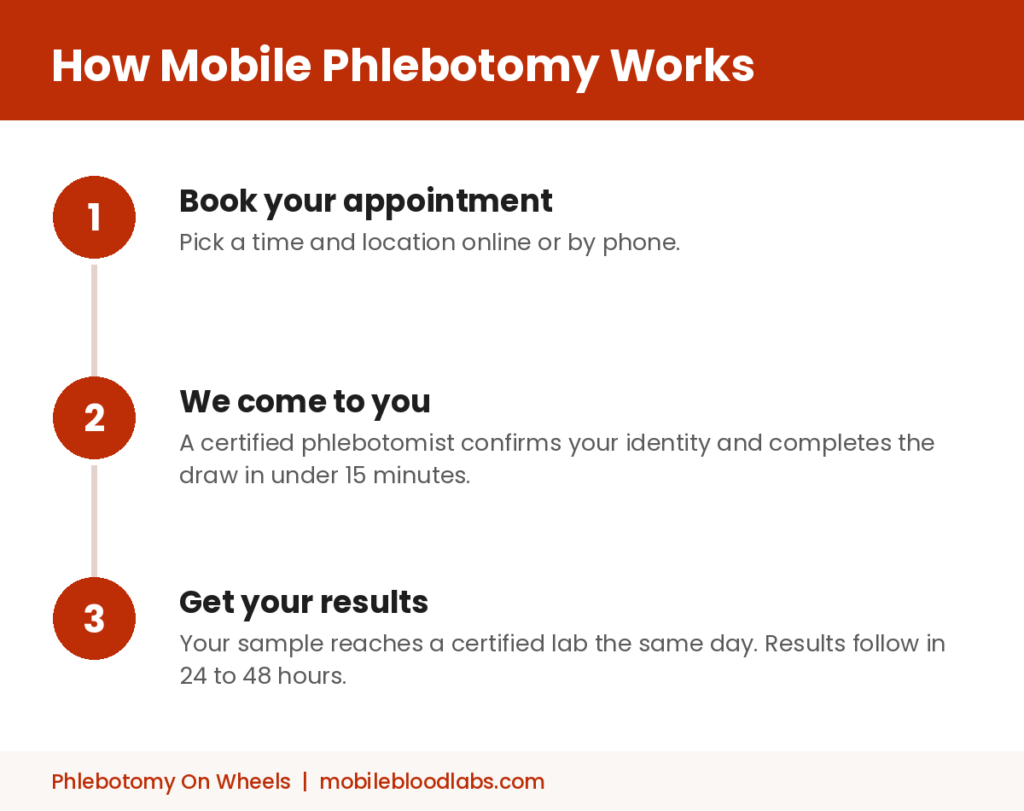
The process is shorter than most people expect:
- You book an appointment, online or by phone, choosing a time and location that fits your day.
- A certified phlebotomist arrives at that location with the same sterile collection kit used in any clinic.
- Your identity is confirmed using two independent identifiers, then the draw happens, typically in under fifteen minutes.
- The sample is labeled and transported to a certified laboratory the same day, under the same chain of custody rules as any lab visit.
- Results are sent to you and your provider on the same timeline a traditional draw would follow, usually 24 to 48 hours for routine tests.
That is the whole process. Nothing skipped, just relocated.
What Is a Mobile Phlebotomist?
A mobile phlebotomist is a certified professional who performs the same collection work as any clinic based phlebotomist, trained and evaluated against the same standards, just without a fixed exam room. Picture the phlebotomist you would meet at any clinic, then picture them arriving at your door with the same kit, the same training, and the same checklist:
- Confirms your identity using two independent identifiers, the same verification standard used in any accredited lab
- Collects blood, urine, or other specimens using sterile, standard technique
- Labels and documents the sample with proper chain of custody
- Transports it safely to a certified laboratory for processing
- Coordinates with your physician or ordering provider when needed
Nothing on that list is a shortcut. It is the same job, moved to your location.
What Does Mobile Phlebotomy Cost?
The collection fee for a mobile visit typically runs $75 to $150, separate from the cost of the lab actually processing your sample. Medicare covers clinical laboratory services at no cost for eligible patients, and Medicaid coverage is usually $0 to $15 depending on your state. If you want the full breakdown by insurance type and test type, that is its own deep dive, see our complete mobile phlebotomy cost guide rather than trying to cram it in here.
So, Is Mobile Phlebotomy Worth It?
Here is the honest version, not the marketing version: it depends what you are trying to protect, your time, your comfort, or your health situation specifically. For most people who get far enough to ask the question, the answer ends up being yes, but let’s look at why instead of just asserting it.
The Worth It Scorecard
| Mobile Phlebotomy | Traditional Lab Visit | |
|---|---|---|
| Time cost | 15 to 30 minutes, at your location | 1 to 3 hours with travel and wait |
| Comfort | High, familiar environment | Moderate, clinical setting |
| Safety for immunocompromised patients | High, no shared waiting room | Lower, shared waiting space |
| Scheduling flexibility | Appointment based, evenings and weekends available | Fixed clinic hours |
| Result accuracy | Identical, same certified lab | Identical, same certified lab |
| Best for mobility limitations | Excellent | Poor |
Read that accuracy row twice. Once your sample reaches the lab, it is processed exactly the same way no matter where it was drawn. You are not trading accuracy for convenience, you are only changing where the fifteen minute part of your day happens.
Three People Who Actually Asked This Question
The daughter managing her mother’s diabetes monitoring. Every few weeks meant coordinating a ride, a wheelchair accessible entrance, and a waiting room her mother found exhausting before the appointment even started. According to the National Council on Aging, 64 percent of older adults surveyed cite transportation as a real barrier to getting care, and roughly 1 in 4 skip appointments entirely because of it. A mobile draw did not just save time, it removed the barrier that was causing appointments to get skipped in the first place. Full guide: mobile phlebotomy for seniors and homebound patients.
The project manager who kept losing her lunch break to a waiting room. Thirty minutes of driving, twenty minutes of waiting, ten minutes of actual appointment, then the drive back, on a day that already had no room in it. Swapping that for a fifteen minute visit at her desk before her first call was not a luxury, it was the difference between getting the test done at all or pushing it another month.
The parent whose son cries before every needle. A clinical waiting room, other patients, fluorescent lighting, none of it helps a nervous seven year old. At home, on his own couch, with his own routine intact around the appointment, the anxiety dropped enough that the actual draw became the easy part of the day.
None of these are hypothetical marketing scenarios, they are the three reasons this question gets searched in the first place.
5 Benefits of Mobile Phlebotomy
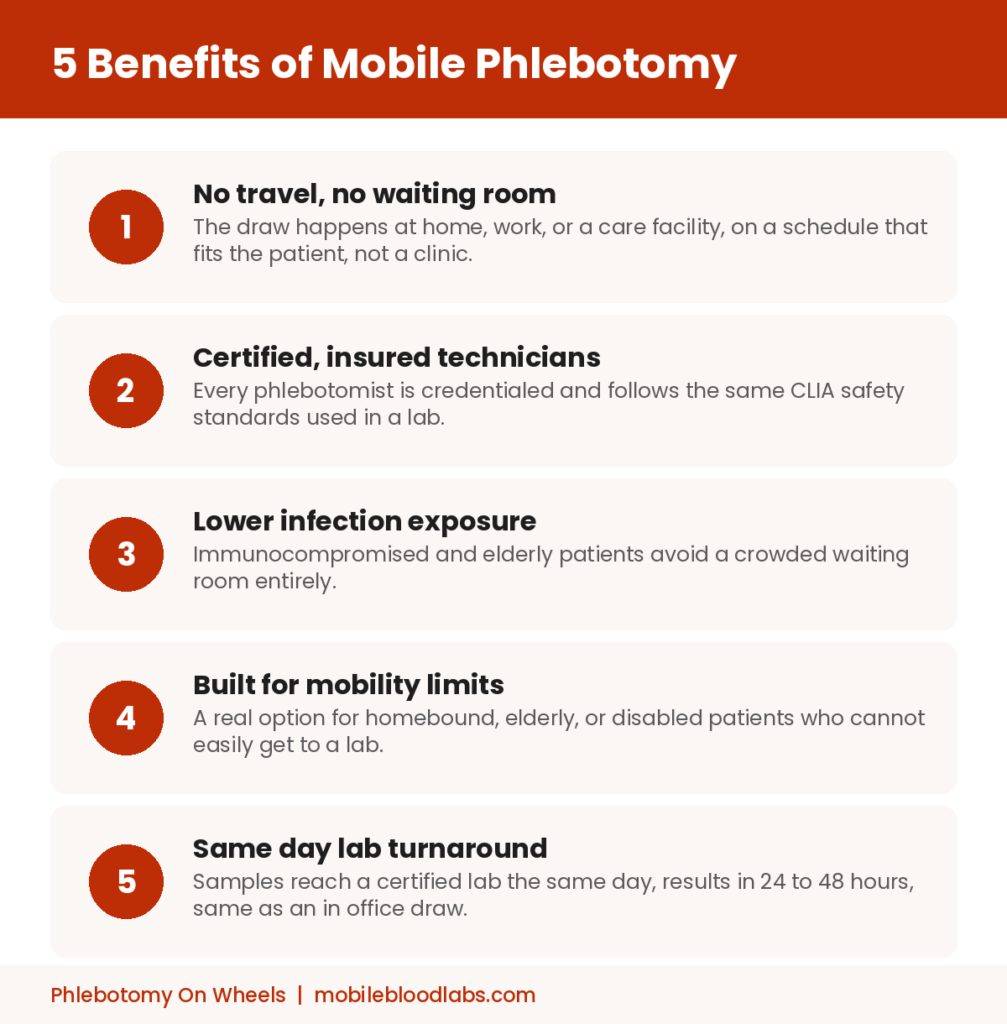
- Time back. No drive, no waiting room, a fifteen to thirty minute visit instead of an hour or more.
- Comfort. A familiar environment instead of a clinical one, which matters most for anxious patients and kids.
- Consistency for chronic conditions. Regular monitoring stops depending on whether you can find time to get to a lab that week.
- Lower exposure risk. No shared waiting room, which matters most for immunocompromised patients.
- Real scheduling flexibility. Evening and weekend appointments exist because the clinic’s open hours are no longer the constraint.
Who It Is Genuinely Best For
- Seniors or anyone with mobility limitations
- Patients managing a chronic condition who need regular monitoring
- Immunocompromised patients avoiding a shared waiting room
- Busy professionals with real time constraints
- Parents of young or anxious children
- Patients in rural areas far from the nearest lab
Who Might Not Need It
- Someone getting a single, one time wellness check with no mobility concerns and easy lab access nearby
- Someone who genuinely prefers the in person clinic experience
Is Mobile Phlebotomy Safe?
Yes, and the reason is simple: it operates under the same rules, not a looser version of them. CLIA standards govern the sterile technique, the identity verification, and the chain of custody handling, regardless of where the draw physically happens. The location changes. The standard does not.
What Is the Difference Between Mobile Phlebotomy and a Lab Visit?
The collection and lab processing are identical. The difference lives entirely in the hour around it, no travel, no waiting room, a draw scheduled around your day instead of a clinic’s open hours. Full side by side breakdown: mobile phlebotomy vs traditional lab.
Where This Is Headed
The mobile phlebotomy industry is projected to keep growing over the next decade, driven by an aging population that needs more frequent monitoring, rising chronic disease rates, and a broader shift toward care that comes to the patient instead of the other way around. Telehealth made this normal for doctor visits first. Lab work is simply catching up to the same expectation, care that fits into your day instead of requiring you to rearrange it around a clinic’s schedule.
Frequently Asked Questions
Yes. Mobile phlebotomists follow the same CLIA regulated standards as any certified laboratory, including sterile technique and two identifier patient verification.
ou book an appointment, a certified phlebotomist arrives at your chosen location with a standard collection kit, confirms your identity, performs the draw in under fifteen minutes, then transports the sample to a certified lab the same day.
Less time lost, more comfort for anxious patients and kids, consistent monitoring for chronic conditions, lower exposure risk in a shared waiting room, and real scheduling flexibility outside standard clinic hours.
The collection fee typically runs $75 to $150 per visit, separate from lab processing costs. See our complete cost breakdown for pricing by insurance type and test type.
For most seniors managing regular monitoring or facing real transportation barriers, yes. See our guide for seniors and homebound patients for the full picture.
The sample collection and processing are identical. The difference is location and convenience. Full comparison here.
No separate order is required to book a routine draw. If your specific test requires a physician’s order, your provider will let you know during scheduling.
Phlebotomy On Wheels provides services nationwide across the United States, with a walk in Patient Service Center in Columbia, Maryland for patients who prefer that option.
Ready to Decide for Yourself?
You do not have to take our word for it, book one visit and compare it to your last lab trip yourself.
Schedule Your At Home Blood Draw →
Related reading:
- Mobile Phlebotomy Cost 2026 — Full pricing and insurance breakdown
- Mobile Phlebotomy vs Traditional Lab — Side by side comparison
- Mobile Phlebotomy for Seniors and Homebound Patients — Full guide
- Mobile Phlebotomy Services — Mobile Phlebotomy Services