
Mobile Phlebotomy vs Traditional Lab: Which Is Better in 2026?

Two Ways to Get Your Blood Drawn
Choosing between mobile phlebotomy vs traditional lab visits is a decision more patients are facing in 2026, as at-home blood draw services become widely available alongside conventional clinic appointments. Both options use the same equipment, the same trained professionals, and the same laboratories for processing. The real differences are in convenience, cost structure, accessibility, and overall experience — not in the medical accuracy of your results.
This guide breaks down exactly how each option works, compares them side by side across the factors that actually matter, and helps you decide which one fits your specific situation. If you haven’t already, you may also want to read our guide on mobile phlebotomy cost in 2026 for full pricing details.
Medical Disclaimer: This article is for educational purposes only. Always follow your physician’s specific instructions for your lab testing needs.
How Mobile Phlebotomy Works

With mobile phlebotomy, a certified phlebotomist travels directly to your home, office, or care facility to perform your blood draw.
The process:
- You book an appointment online or by phone
- A certified phlebotomist arrives at your scheduled time with all necessary sterile equipment
- The draw is performed in your chosen location, a kitchen table, a recliner, even in bed if needed
- Samples are properly labeled and transported directly to the lab
- Results are sent to your provider, typically within 24-48 hours
The procedure itself, needle insertion, sample collection, labeling, chain of custody, follows the exact same clinical standards as an in-clinic draw. The only thing that changes is the location.
How a Traditional Lab Visit Works
A standard lab appointment follows a different sequence:
- You schedule or walk in during business hours
- You travel to the facility’s physical location
- You check in and wait in a shared waiting room
- A phlebotomist at the facility performs your draw
- You travel home
- Results are sent to your provider, typically within 24-48 hours
For some patients, this works perfectly well, particularly when a lab is close by, parking is easy, and the patient has no mobility or scheduling constraints.
Mobile Phlebotomy vs Traditional Lab: Full Comparison
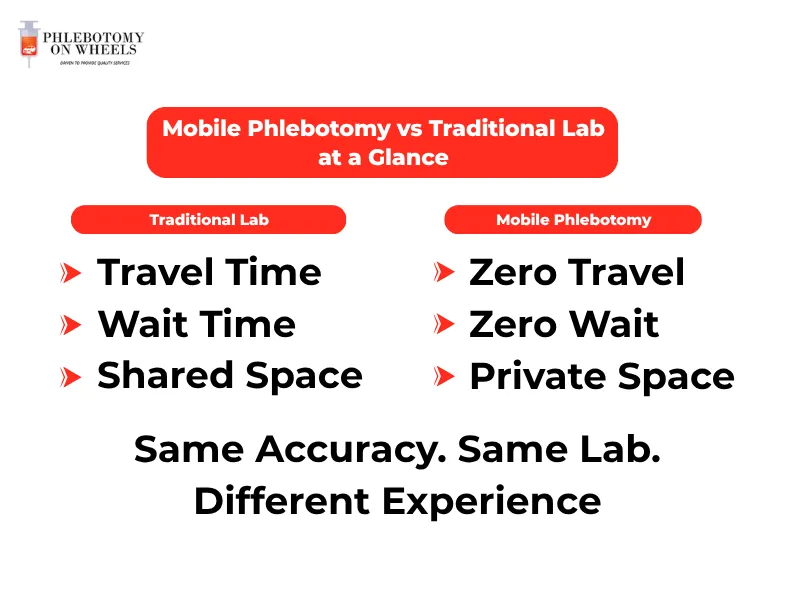
accessibility, not accuracy.
Cost Comparison
According to industry pricing data, this mobile option typically costs $75-$150 per visit as a collection fee, separate from lab processing costs. An in-clinic visit typically has $0-$20 in direct facility fees, with the same lab processing cost applying either way.
However, cost isn’t just the sticker price. A clinic visit that requires taking time off work, paying for parking, and factoring in travel time often carries a real “true cost” close to or exceeding the mobile service fee, once your time is factored in.
For a complete breakdown including Medicare, Medicaid, and private insurance coverage scenarios, see our full cost guide.
Time Comparison
| Factor | At-Home Visit | In-Clinic Visit |
|---|---|---|
| Travel time | 0 minutes | 20-40 minutes round trip |
| Wait time | 0 minutes (appointment-based) | 15-60+ minutes |
| Draw time | 5-10 minutes | 5-10 minutes |
| Total time investment | 15-30 minutes | 45-90+ minutes |
Accuracy Comparison
This is the most important point to understand: accuracy does not change based on location. Phlebotomists performing at-home draws use identical sterile equipment, identical labeling and chain-of-custody procedures, and send samples to the same accredited laboratories that clinics use. According to the CDC’s clinical laboratory standards, proper specimen collection protocol, not the physical location of collection, is what determines result accuracy. Once a sample reaches the lab, it is processed exactly the same way regardless of where it was collected.
Comfort and Accessibility Comparison
| Factor | At-Home Visit | In-Clinic Visit |
|---|---|---|
| Environment | Familiar, private | Clinical, shared waiting room |
| Mobility requirements | None. Stay seated or in bed | Must walk, sit, navigate facility |
| Infection exposure | Minimal (private setting) | Higher (shared public space) |
| Anxiety management | Personalized, private | Limited, public setting |
| Fall risk | Eliminated | Present (parking lots, hallways) |
Who Should Choose Mobile Phlebotomy
This option tends to be the better fit for:
- Seniors and homebound patients: See our complete guide for seniors for Medicare coverage details and what to expect
- Busy professionals: Who want to eliminate travel and waiting room time entirely
- Parents of young children: Who need pediatric blood draws without a stressful clinic visit
- Patients managing chronic conditions: Who need frequent, predictable testing through standing orders
- Anyone with needle anxiety: Who benefits from a private, unhurried environment, see our preparation guide for anxiety management techniques
- Rural patients: Who live far from the nearest lab facility
- Anyone needing urgent same-day results: Through our STAT draw service
Who Should Choose a Traditional Lab Visit
An in-clinic appointment may make more sense when:
- You live within walking distance or a very short drive of a lab, with no mobility concerns
- You need a test that requires specialized in-facility equipment not available through at-home collection
- You’re already at a clinic for another appointment and can combine the visit
- You have no schedule flexibility and the lab’s walk-in hours fit your day better than a scheduled mobile appointment
Can You Use Both? (Hybrid Approach)
Yes, and many patients do exactly this. There’s no rule requiring you to permanently choose one side of the mobile phlebotomy vs traditional lab decision. Some patients use an at-home service for routine or recurring testing (where convenience and consistency matter most) and use a clinic for occasional one-off tests that happen to align with another errand or appointment.
The right approach is whichever keeps you consistent with your doctor’s recommended testing schedule, consistency matters more than which option you choose each time.
Common Myths About Mobile Phlebotomy
Myth: At-home blood draw results are less accurate. False. Identical equipment, identical lab processing, see the Accuracy Comparison section above.
Myth: Insurance never covers mobile phlebotomy. False. Medicare covers clinical laboratory services at no cost for eligible patients, and Medicaid and private insurance frequently provide coverage as well. See our cost and insurance guide for details, or visit Medicare.gov directly.
Myth: You need a special reason to qualify for this service. False, for self-pay patients. While Medicare’s full coverage requires homebound status, anyone can book and pay for an at-home draw regardless of medical necessity.
Myth: Mobile phlebotomy takes longer to get results. False. Results timing is determined by the laboratory processing the sample, not by where the sample was collected, typically 24-48 hours either way.
Frequently Asked Questions
A: Yes. Phlebotomists performing at-home visits are certified professionals using sterile, single-use equipment and following the same clinical safety standards used in any lab setting.
A: No. Results depend on laboratory processing time, not collection location. Most routine tests return results in 24-48 hours regardless of which option you choose.
A: Yes. There’s no restriction preventing you from using whichever option makes sense for each individual test or appointment.
A: Lab processing fees are typically covered the same way either option. The mobile collection fee itself may have different coverage depending on your plan, see our detailed cost and insurance breakdown.
A: Yes, through our STAT draw service, designed specifically for time-sensitive testing needs.
A: An at-home visit tends to work better for anxious patients, since the private, familiar setting allows for a slower, more personalized approach. Our preparation guide includes specific anxiety management techniques.
Ready to Book?
Both options get you accurate, professional results, the right choice depends on your schedule, mobility, and comfort preferences.
Schedule Your At-Home Blood Draw Today →
Sources & Citations
- Medicare.gov — Medicare Costs & Coverage 2026
- Medicaid.gov — State Coverage Information
- Healthcare.gov — Health Insurance Coverage
- CDC — Clinical Laboratory Improvement Amendments (Quality Standards)
Walk in Available
4 Responses