
At Home Therapeutic Phlebotomy: How It Works, Who Can Order It, And What A Visit Looks Like

When your doctor orders regular blood removal, the hardest part is often the schedule, not the procedure. Weekly trips to a hospital, an infusion center or a donation site take hours out of your week, which is why more patients ask about at home therapeutic phlebotomy. A certified phlebotomist comes to your door, follows your physician’s order and removes the prescribed amount of blood in the comfort of your own home. Phlebotomy On Wheels provides therapeutic phlebotomy nationwide, including in Maryland, Virginia and Washington, DC.
This guide explains how the visit works, who it is for, how often it is done and how to set it up with your doctor.
The short answer: At home therapeutic phlebotomy is a physician directed procedure in which a certified phlebotomist removes a set amount of blood, typically about one unit (500 mL), at your home to treat a condition such as hemochromatosis or polycythemia vera. Your doctor’s verbal order is enough to start. For hemochromatosis, visits are usually weekly at first, then a few times a year once your levels are on target.
Already Have Your Doctor’s Order?
Medical Disclaimer: This article is for educational purposes only and is not medical advice. Always consult your physician about whether therapeutic phlebotomy is right for your condition.
What At Home Therapeutic Phlebotomy Means
Therapeutic phlebotomy is the planned removal of blood to treat a medical condition. A physician decides how much blood to remove and how often, and the phlebotomist follows that order exactly. At home therapeutic phlebotomy changes where the visit happens, not what the order says.
You may also hear it called mobile therapeutic phlebotomy or a therapeutic blood draw at home. They all describe the same thing: a trained professional travels to you instead of you traveling to a facility.
It is different from a routine blood draw. A routine draw fills a few tubes for lab work. Therapeutic phlebotomy removes a much larger planned volume, usually about a pint, because the goal is treatment, not a lab sample.
Who Qualifies For Therapeutic Phlebotomy
Only a physician can decide that you need therapeutic phlebotomy. These are the most common reasons, with what published guidance says about each.
Hemochromatosis
Hereditary hemochromatosis causes the body to absorb too much iron. The CDC reports that about 1 in 300 non Hispanic white people in the United States, more than 650,000 people, carry two copies of the C282Y gene change linked to most cases. Not everyone with that gene change becomes seriously ill, but the CDC notes that up to 10% of male carriers of two copies develop severe liver disease, and that serious liver damage can be avoided if regular phlebotomy begins before cirrhosis develops.
The American College of Gastroenterology recommends phlebotomy as the first line treatment for diagnosed hemochromatosis.
Polycythemia Vera
Polycythemia vera causes the bone marrow to make too many red blood cells, which raises hematocrit and the risk of clots. In a randomized trial of 365 adults published in the New England Journal of Medicine in 2013, patients treated to keep hematocrit below 45% had fewer cardiovascular deaths and major clots (2.7%) than patients held at 45% to 50% (9.8%). Phlebotomy is a standard way to lower hematocrit, often alongside other treatment your hematologist chooses.
Other Physician Directed Reasons
Doctors also order therapeutic phlebotomy for iron overload caused by repeated transfusions and for other conditions that cause too many red blood cells. If your physician has written a treatment plan that calls for blood volume reduction, an at home visit can carry it out.
How Often At Home Therapeutic Phlebotomy Is Done
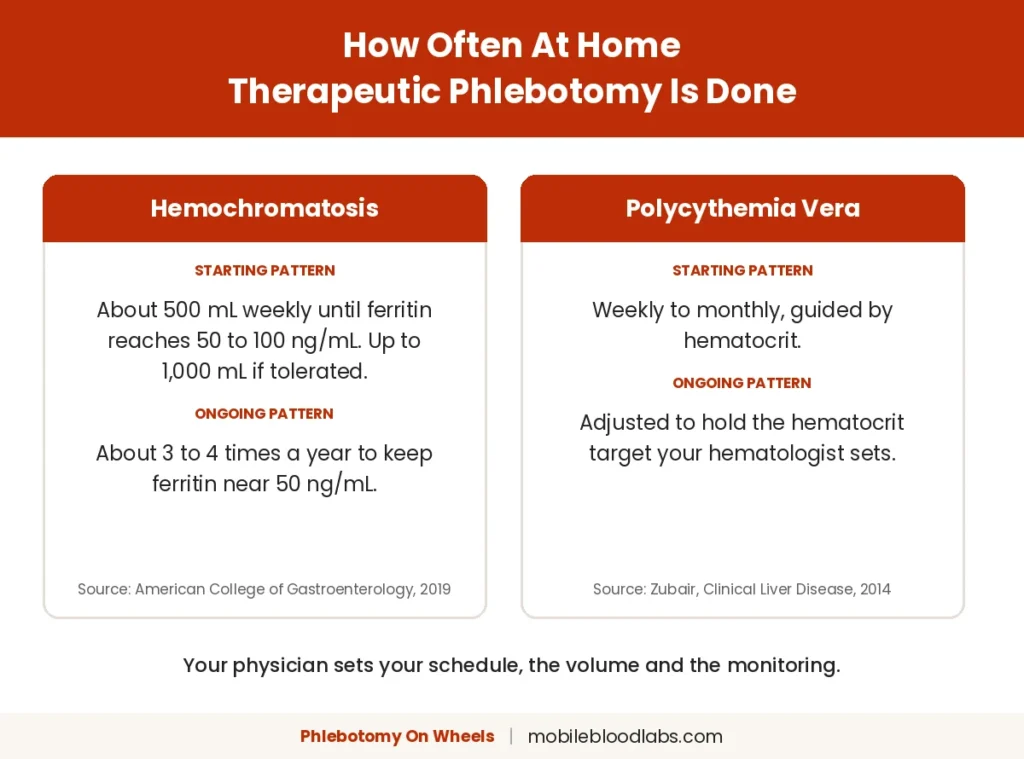
Your physician sets your therapeutic phlebotomy schedule. Published guidance gives a useful picture of what to expect.
| Condition | Typical starting pattern | Typical ongoing pattern | Source |
|---|---|---|---|
| Hemochromatosis | About 500 mL weekly until ferritin reaches 50 to 100 ng/mL. Up to 1,000 mL if tolerated. | About 3 to 4 times a year to keep ferritin near 50 ng/mL | American College of Gastroenterology, 2019 |
| Polycythemia vera | Weekly to monthly, guided by hematocrit | Adjusted to hold the hematocrit target your hematologist sets | Zubair, Clinical Liver Disease, 2014 |
Two safety points from the same guidance. Hemoglobin should be checked before and during treatment to keep it above 11 g/dL, and patients with a small body size or heart or lung conditions may have a smaller volume removed, such as half a unit (250 mL). Your doctor orders the monitoring bloodwork and sets the volume for each visit.
What An At Home Therapeutic Phlebotomy Visit Looks Like
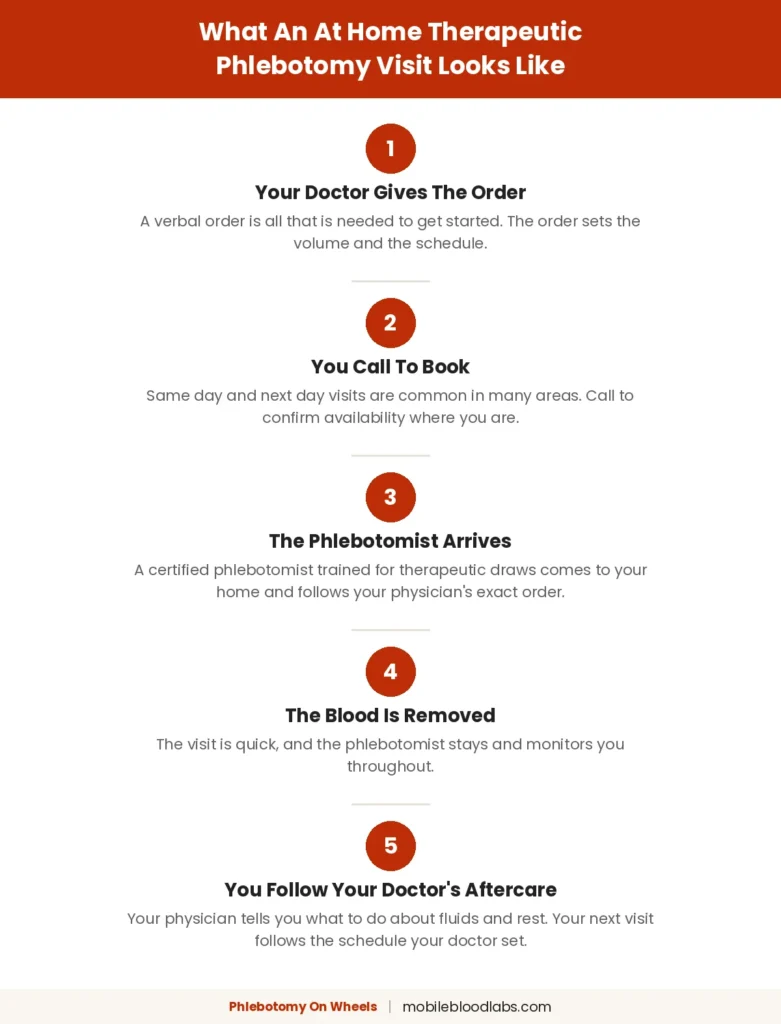
- Your doctor gives the order. A verbal order is all that is needed to get started, with no written prescription required. The order sets the volume and the schedule.
- You call to book. Call (443) 866-3647. Same day and next day appointments are common in many areas, so call to confirm availability where you are.
- The phlebotomist arrives. A certified phlebotomist trained for therapeutic draws comes to your home and follows your physician’s exact order.
- The blood is removed. The visit is quick, usually just a few minutes, depending on the volume and your health. The phlebotomist stays and monitors you throughout.
- You follow your doctor’s aftercare. Your physician tells you what to do about fluids and rest, and your next visit is booked on the schedule your doctor set.
Skip The Waiting Room
How To Set Up Therapeutic Phlebotomy At Home With Your Doctor
Setting it up takes one conversation with your physician. Who can order therapeutic phlebotomy? Your treating physician, such as a primary care doctor or a hematologist. Ask them to give the order to Phlebotomy On Wheels verbally, then call to book. If you currently go to a hospital or donation site, ask whether the same order can be carried out at home. The order does not change. Only the location does.
Questions worth asking your doctor:
- How much blood should be removed at each visit?
- How often, and for how long, before we move to a maintenance schedule?
- What target are we aiming for, and which labs will you order to track it?
- Can you give the order verbally to my at home provider?
- What should I do before and after each visit?
Mobile Therapeutic Phlebotomy Compared To A Hospital Or Infusion Center
When a mobile phlebotomist performs a therapeutic blood draw at your home, the treatment is the same. The experience around it is not.
- Travel and parking: none for you. The phlebotomist comes to your home.
- Waiting: no waiting room, so a visit fits around work and family.
- Scheduling: booked by phone, with same day and next day visits common in many areas.
- What stays the same: your physician’s order, the volume removed and a certified professional doing the draw.
What At Home Therapeutic Phlebotomy Costs
Visits start at $100. Final pricing depends on your location, mileage and how often you need visits. It is a self pay service, paid at the time of the visit, and it is not billed to insurance. Call (443) 866-3647 for an exact quote before you book. For a full breakdown, read our guide to therapeutic phlebotomy cost.
Want Your Exact Price?
Key Takeaways
- At home therapeutic phlebotomy is physician directed blood removal done at your home by a certified phlebotomist.
- A verbal order from your doctor is enough to start.
- For hemochromatosis, guidance describes about 500 mL weekly at first, then about 3 to 4 times a year to stay on target.
- Your doctor sets the volume, the schedule and the monitoring. The phlebotomist follows the order exactly.
- Visits start at $100, with final pricing based on location, mileage and frequency.
Can I get at home therapeutic phlebotomy without a written prescription?
Yes. Your physician’s verbal order is enough to get started. Your doctor still directs the volume and the schedule.
What is the difference between therapeutic phlebotomy and a routine blood draw?
A routine blood draw fills a few tubes for lab work. Therapeutic phlebotomy removes a larger planned volume, usually about one unit (500 mL), to treat a condition.
How do I know when to move from weekly visits to maintenance visits?
Your doctor decides based on your lab results. For hemochromatosis, the American College of Gastroenterology describes about 500 mL weekly until ferritin reaches 50 to 100 ng/mL, then about 3 to 4 visits a year.
Can I switch from a hospital or donation site to at home visits?
Yes. Ask your doctor to give the same order to Phlebotomy On Wheels, then call (443) 866-3647 to book. The order stays the same and only the location changes.
How much does at home therapeutic phlebotomy cost?
Visits start at $100. Final pricing depends on your location, mileage and how often you need visits. It is a self pay service. Call (443) 866-3647 for an exact quote.
Related Reading
- Therapeutic Phlebotomy Services
- Is Therapeutic Phlebotomy Medically Supervised? What To Expect
- Therapeutic Phlebotomy For High Hemoglobin: Now What?
- Therapeutic Phlebotomy Cost: What To Expect In 2026
- Mobile Phlebotomy Services
- Therapeutic Phlebotomy In Maryland
- Therapeutic Phlebotomy In Virginia
- Therapeutic Phlebotomy In Washington, DC
Sources & Citations
- Kowdley KV, Brown KE, Ahn J, Sundaram V. ACG Clinical Guideline: Hereditary Hemochromatosis. American Journal of Gastroenterology, 2019;114:1202 to 1218.
- Zubair A. Therapeutic Phlebotomy. Clinical Liver Disease, 2014;4(5):102 to 106.
- Marchioli R, et al. Cardiovascular Events and Intensity of Treatment in Polycythemia Vera. New England Journal of Medicine, 2013.
- Centers for Disease Control and Prevention. Are We Ready for Population Screening for Hereditary Hemochromatosis? CDC Genomics and Health Impact Blog, 2020.
3 Responses