
Blood Labs in Maryland: Where to Get Routine Labs Done at Home
Looking for blood labs in Maryland that don’t cost you an entire morning? You booked the appointment three weeks ago, took the morning off, drove twenty minutes, found parking, and sat in a waiting room for forty-five more, only to find out the lab doesn’t do that particular panel on Tuesdays. Sound familiar?
It’s not just you. Scheduling friction is a real, measured problem in healthcare, not just an annoying feeling: no-shows and last-minute cancellations already eat up roughly 14% of a medical practice’s daily revenue nationwide, according to a 2026 MGMA patient access report, which means the system itself knows getting people in for routine care is harder than it should be.
Here’s the part most people in Maryland don’t know: it doesn’t have to be this hard. Blood labs in Maryland aren’t limited to a clinic or a hospital anymore. A certified phlebotomist can come to your kitchen table, your office, or wherever your day actually happens, and your sample goes to the exact same certified lab either way.
This guide covers where to actually get routine labs done in Maryland, what counts as “routine” testing, how often you really need it, what it costs, and how to set it up on a recurring schedule if that’s what you need.
Medical Disclaimer: This article is for educational purposes only. Always consult a healthcare provider about specific lab testing needs. Pricing and availability are current as of 2026 and may vary by location.
Blood Labs in Maryland: Where to Actually Get Routine Labs Done
Maryland residents generally have three real options for routine lab work, and they are not all the same experience.
1. A traditional clinic or hospital lab. Walk in or schedule ahead, then wait for your name to be called. Predictable if your schedule is flexible. Painful if it isn’t.
2. A standalone patient service center. Usually faster than a hospital lab, still requires travel and some wait, though often shorter than a hospital setting.
3. A mobile phlebotomy service. A certified phlebotomist comes to your home, office, or wherever fits your day. Same certified lab, same test panel, same accuracy as either option above. The only thing that changes is where the fifteen-minute draw happens.
For Maryland residents who’d rather have a physical location, there’s also a walk-in Patient Service Center at 5457 Twin Knolls Rd Suite 300, Columbia, MD 21045, open Monday through Friday, 7:00 AM to 7:00 PM EST.
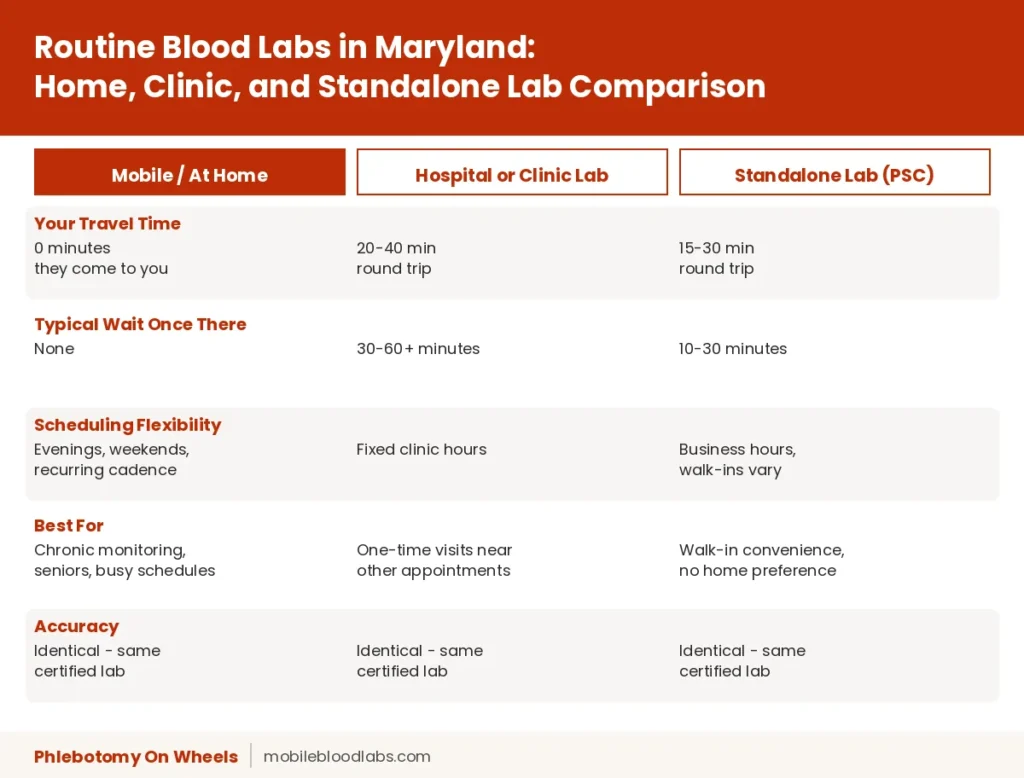
Routine Blood Labs: Home vs. Clinic vs. Standalone Lab
| Mobile / At Home | Hospital or Clinic Lab | Standalone Lab (PSC) | |
|---|---|---|---|
| Your travel time | 0 minutes, they come to you | 20 to 40 minutes round trip | 15 to 30 minutes round trip |
| Typical wait once there | None | 30 to 60+ minutes | 10 to 30 minutes |
| Scheduling flexibility | Evenings, weekends, recurring cadence available | Fixed clinic hours | Business hours, walk-ins vary |
| Best for | Chronic monitoring, seniors, busy schedules, anxious kids | One-time visits near other appointments | Walk-in convenience, no home preference |
| Accuracy | Identical, same certified lab | Identical, same certified lab | Identical, same certified lab |
Read that accuracy row twice. Once the sample reaches the lab, it’s processed exactly the same way no matter which column it came from. The only thing that actually changes across this table is where your time goes.
What Counts as a Routine Blood Draw?
“Routine” isn’t one specific test. It’s a category, the standard panels a doctor orders for regular monitoring rather than an urgent or specialty need:
- Complete Blood Count (CBC)
- Comprehensive Metabolic Panel (CMP)
- Lipid panel (cholesterol, triglycerides, HDL/LDL)
- Thyroid panel (TSH)
- A1C (diabetes monitoring)
- Vitamin D and other deficiency screenings
If a doctor has ordered any of these on a recurring basis, weekly, monthly, or quarterly, that’s routine testing. It’s also exactly what a mobile draw is built for.
How Often Should You Actually Get Routine Blood Work Done?
There’s no single answer, it depends on the test and your own risk factors, but there are real published benchmarks worth knowing:
- Cholesterol/lipid panel: every 4 to 6 years for average-risk adults, according to health.gov (U.S. Department of Health and Human Services), more frequently if you have a family history of high cholesterol or heart disease.
- A1C/diabetes monitoring: typically every 3 months for anyone actively managing diabetes, per standard care guidance from most endocrinologists.
- CBC and metabolic panels for chronic condition management: frequency is set by your doctor based on the specific condition, often monthly or quarterly.
- General wellness panels with no known risk factors: usually annually, tied to a yearly physical.
The real point: if a doctor has you on a recurring testing schedule, sticking to it consistently matters more than any specific interval. A mobile routine blood draw is built to make that consistency easier, not harder.
Weekly and Monthly Routine Labs in Maryland
The clinic-visit model works fine for a one-time test. It gets old fast when it’s recurring.
Anyone managing a chronic condition, diabetes, heart disease, thyroid issues, knows the real cost of routine labs isn’t the test itself, it’s doing the same drive and the same waiting room every few weeks. A mobile routine blood draw removes that part entirely: book once, and future visits can follow the same weekly or monthly cadence without re-booking each time. Standing order service is built for exactly this, scheduled recurring visits set up once. For more on how that works, see what are standing orders for lab work.
Who Actually Needs Routine Labs at Home?
The retiree in Columbia managing type 2 diabetes. Quarterly A1C checks used to mean a ride from a family member, a wait in a crowded lab, and an afternoon gone. Switching to a recurring at-home draw meant the testing stayed exactly as consistent, but the disruption disappeared.
The Rockville parent with a needle-anxious ten-year-old. A pediatric wellness panel at a clinic meant a waiting room full of sick patients and a kid who’d already worked himself up before the draw even started. At home, on his own couch, the appointment became the calm part of the day instead of the dreaded part.
The Bethesda professional juggling two jobs. A quarterly lipid panel used to mean losing a lunch break to traffic and a waiting room. Now it’s fifteen minutes at a desk between meetings.
None of these are hypothetical. They’re the three real reasons “blood labs in Maryland” gets searched in the first place, not a single generic use case.
Who It’s Genuinely Best For
- People managing a chronic condition who need consistent, uninterrupted monitoring
- Seniors and homebound patients, for whom a clinic trip is a real barrier, not a minor inconvenience. Full guide: mobile phlebotomy for seniors
- Busy professionals who’d rather not lose an hour of a workday for a fifteen-minute test
- Parents of anxious kids who do better in a familiar setting
- Anyone in Baltimore, Annapolis, Frederick, Silver Spring, Gaithersburg, Towson, Ellicott City, or across Montgomery, Howard, Anne Arundel, or Prince George’s County who’d rather skip the drive entirely
Who Might Not Need It
- Someone getting a single, one-time wellness check who doesn’t mind a short clinic visit
- Someone who genuinely prefers the in-person clinic experience
How It Works
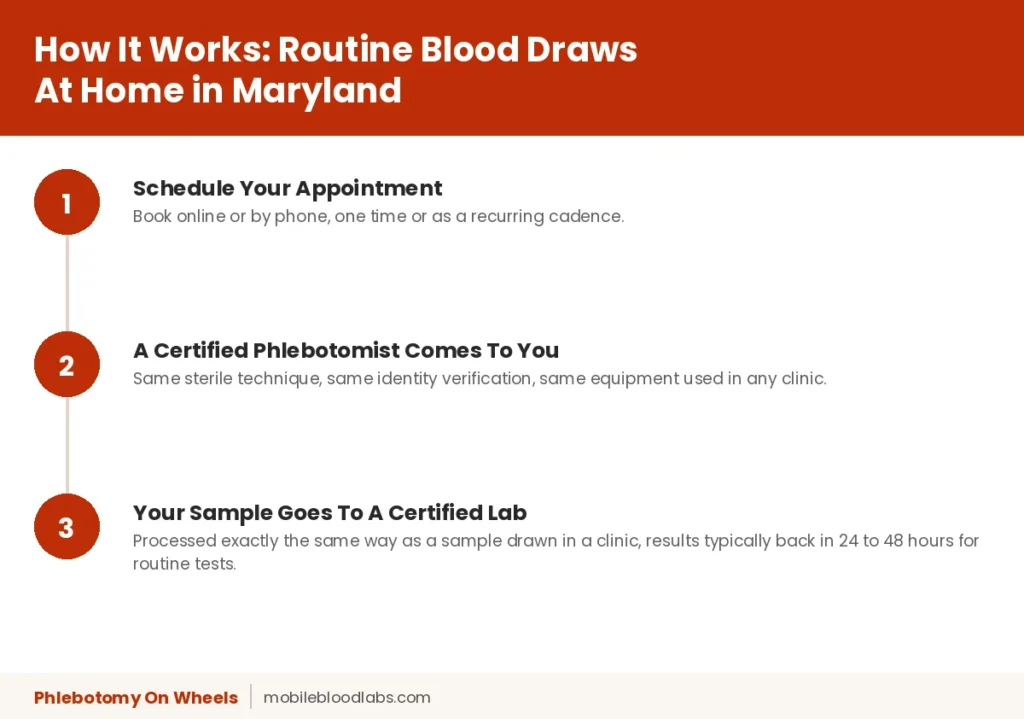
- Schedule your appointment. Book online or by phone, one time or as a recurring cadence.
- A certified phlebotomist comes to you. Same sterile technique, same identity verification, same equipment used in any clinic.
- Your sample goes to a certified lab. Processed exactly the same way as a sample drawn in a clinic, results typically back in 24 to 48 hours for routine tests.
Full side-by-side comparison of the process itself: mobile phlebotomy compared to a traditional lab visit.
Frequently Asked Questions
Phlebotomy On Wheels sends a certified mobile phlebotomist to your home, office, or another location that works for your schedule, anywhere in Maryland, including Baltimore, Columbia, Rockville, Bethesda, Annapolis, Frederick, and surrounding areas. A walk-in option is also available at our Patient Service Center in Columbia, MD, for anyone who prefers an in-person visit.
Yes. Recurring routine testing can be scheduled on a weekly or monthly cadence through the standing orders service, so it doesn’t need to be re-booked each time.
Phlebotomy On Wheels is a self-pay service, starting at $100 for the collection fee, separate from the lab processing fee. For the full breakdown by test type, see the mobile phlebotomy cost guide.
It depends on the test. Cholesterol panels are generally recommended every 4 to 6 years for average-risk adults, A1C testing is typically every 3 months for anyone managing diabetes, and chronic condition monitoring frequency is set by your doctor. Consistency matters more than the exact interval.
Yes. The sample goes to the same certified laboratory and is processed the same way regardless of where it was collected. The only difference is the location of the draw itself.
In most cases, yes, a doctor’s order is required for lab testing, whether drawn at home or in a clinic. A verbal order is accepted, a written prescription isn’t required.
Most routine panels include some combination of a CBC, comprehensive metabolic panel, lipid panel, thyroid panel (TSH), and A1C, depending on what your doctor has ordered.
Yes, and it’s one of the most common reasons Maryland families book a mobile draw with Phlebotomy On Wheels. It removes the transportation barrier entirely for seniors managing regular monitoring. Full guide: mobile phlebotomy for seniors.
Both. A walk-in Patient Service Center is available at 5457 Twin Knolls Rd Suite 300, Columbia, MD 21045, Monday through Friday 7:00 AM to 7:00 PM EST, in addition to at-home and office visits anywhere in the service area.
Phlebotomy On Wheels offers routine blood draw services throughout Maryland, including Baltimore, Columbia, Rockville, Bethesda, Annapolis, Frederick, Silver Spring, Gaithersburg, Towson, Ellicott City, and beyond, plus Montgomery, Howard, Anne Arundel, and Prince George’s counties. Call to confirm availability at your exact location.
Key Takeaways
- Blood labs in Maryland aren’t limited to clinics or hospitals, a certified mobile phlebotomist can draw the same routine panels at home or the office.
- “Routine” covers CBC, metabolic panels, lipid panels, thyroid panels, and A1C, whatever a doctor has ordered on a recurring basis.
- Recommended testing frequency varies by test: roughly every 4 to 6 years for cholesterol in average-risk adults, every 3 months for A1C in diabetes management, per your doctor for chronic condition monitoring.
- Weekly and monthly recurring testing can be set up once through standing orders, no need to re-book every time.
- Pricing starts at $100 for the collection fee, self-pay, not billed to insurance, Medicare, or Medicaid.
- A walk-in option exists in Columbia, MD, for anyone who’d rather not do a home visit.
Ready to Schedule Routine Labs in Maryland?
Skip the waiting room and get routine blood work done on your own schedule.
Schedule Your Routine Blood Draw Today →
Related Reading
- Routine Blood Draw Service Maryland
- Mobile Phlebotomy Cost 2026
- Mobile Phlebotomy for Seniors
- What Are Standing Orders for Lab Work
- Mobile Phlebotomy Compared to Traditional Lab